
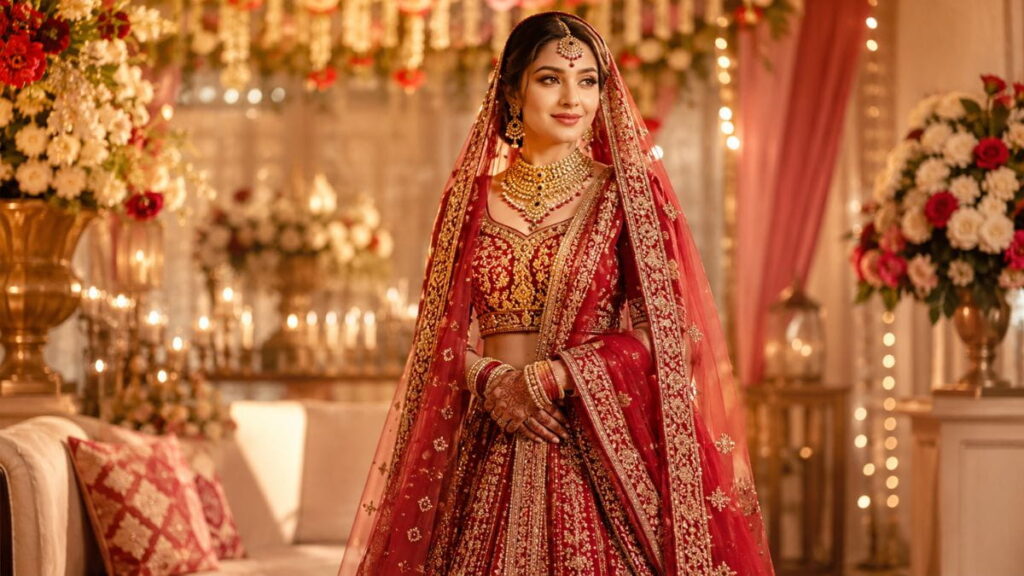
Bridal AI fashion prompts are changing the way designers, boutique owners, and brides-to-be plan wedding looks before a single stitch is sewn. Instead of flipping through hundreds of Pinterest boards or waiting weeks for a designer sketch, you can now type a few carefully chosen words into tools like Midjourney, DALL-E, or Adobe Firefly and watch a full bridal concept appear in seconds.
If you’ve ever stared at a blank prompt box wondering what to type, this guide hands you 50 ready-to-use bridal AI fashion prompts, organized by style, so you never run out of ideas again.
Whether you’re a boutique owner building a lookbook, a fashion student experimenting with concepts, or a bride hunting for inspiration before her big day, these prompts are written to work straight out of the box. Copy, tweak the details (fabric, color, region, mood), and generate.
Why Bridal AI Fashion Prompts Are a Game-Changer
A few years ago, visualizing a bridal outfit meant sketching by hand, hiring an illustrator, or sourcing dozens of reference photos and hoping a tailor could piece the vision together. Bridal AI fashion prompts remove that bottleneck entirely. A well-written prompt can generate a photorealistic or illustrated bridal look in under a minute, giving designers a starting point they can refine instead of a blank page they have to fill.
For boutique owners, this means faster client pitches. Instead of describing a lehenga in words, you can show three AI-generated variations in the time it takes to boil a kettle. For brides, it means walking into a designer’s studio with a clear reference instead of a vague Pinterest collage. And for hobbyists and students, bridal AI fashion prompts are simply one of the most fun ways to explore wedding fashion without touching a needle.
The catch is that not every prompt produces something usable. Vague inputs like “beautiful bridal dress” give you generic, forgettable results. The prompts below are built with the specificity that actually gets AI tools to produce something you’d want to pin, print, or hand to a tailor.
There’s also a practical business angle worth mentioning. Boutique owners who use bridal AI fashion prompts as part of their client consultation process report shorter decision-making cycles, because a bride who can see three or four visual directions side by side makes up her mind faster than one working from swatches and sketches alone.
Designers use the same prompts to stress-test a silhouette before committing fabric and labor to it. And content creators in the fashion space use bridal AI fashion prompts to keep a steady stream of visual content flowing without needing a studio, a model, or a shoot budget every single week.
None of this replaces a skilled tailor or a real photoshoot for the final product. What it replaces is the guesswork that used to happen before either of those steps. Think of bridal AI fashion prompts as the sketching phase of wedding fashion, compressed from days into minutes.
How to Write a Bridal AI Fashion Prompt That Works
Before jumping into the 50 prompts, it helps to understand the anatomy of a strong bridal AI fashion prompts. Every good prompt in this guide follows a loose formula:
Subject + Garment + Fabric + Color + Setting + Lighting + Mood + Style reference
For example, instead of writing “bridal lehenga,” a stronger prompt reads: “A young bride wearing a deep red silk lehenga with gold zari embroidery, standing in a sunlit palace courtyard, soft golden-hour lighting, romantic and regal mood, editorial fashion photography style.”
Notice how each part adds information the AI can actually use. Fabric tells it texture. Setting tells it background. Lighting tells it mood. This is the difference between a flat, generic image and one that looks like it belongs in a wedding magazine.
Keep these tips in mind as you use the prompts below:
- Be specific about fabric. Silk, velvet, organza, and net all render very differently.
- Name the region or culture if you want authenticity (South Indian silk saree, Rajasthani bandhani, Bengali red-and-white saree).
- Add a lighting cue. “Golden hour,” “soft studio light,” and “candlelit” each change the entire feel of the image.
- Reference a photography style like editorial, documentary wedding photography, or fine art portraiture for more polished results.
- Iterate. Your first output is rarely your best. Change one variable at a time (color, pose, background) rather than rewriting the whole prompt.
One habit that separates strong prompt-writers from beginners is treating the prompt like a short creative brief rather than a search query. A search query asks a system to find something that already exists. A prompt asks a system to build something new, which means the more context you give it, the closer the result lands to what you actually pictured.
If you find yourself typing three or four words and hoping for magic, that’s usually the moment to stop and ask what a human stylist would need to know before sketching the same outfit — fabric, color, occasion, mood, and setting are almost always the answer.
It’s also worth keeping a personal “prompt library” as you experiment. Save the exact wording that produced a result you liked, along with a note on which AI tool and settings you used. Over time this becomes a reusable style guide specific to your own taste, and it saves you from re-inventing a working formula every time you sit down to generate new bridal concepts.
Now, let’s get into the prompts.
Traditional Indian Bridal Sarees & Lehengas
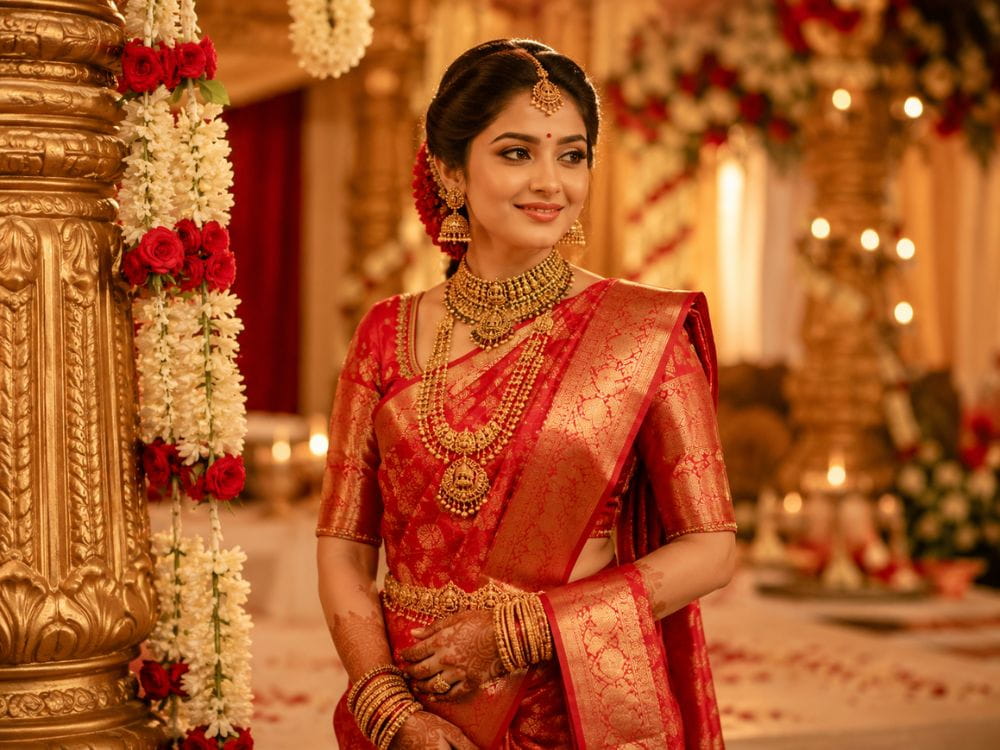
Traditional wear remains the most searched bridal category, and it’s where AI tools genuinely shine once you give them enough cultural and textile detail. This is exactly the kind of category where bridal AI fashion prompts perform best, because traditional bridal fashion has such a rich, well-documented visual history — decades of wedding photography, film costuming, and editorial shoots.
AI models generally have a strong reference base to draw from for this category. The results tend to be more accurate here than in newer or more niche fashion categories, provided the prompt names the right textile, region, and jewelry style rather than relying on generic terms like “Indian bridal dress.”
How to Apply This Prompt
Start with the base formula above, then layer in region-specific textile names (Banarasi, Kanjeevaram, Patola) since AI models have been trained on enough tagged imagery to recognize these terms and render them with reasonable accuracy.
Modern Fusion Bridal Outfits
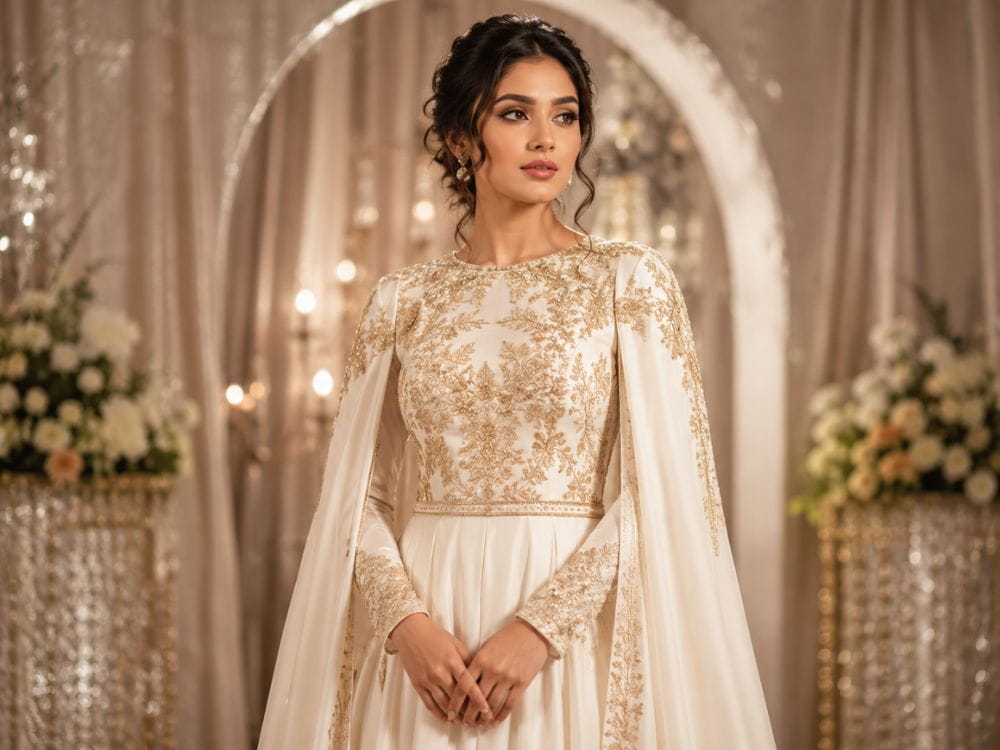
Fusion bridalwear blends Western silhouettes with traditional embellishment, and it’s one of the fastest-growing categories among younger brides using bridal AI fashion prompts today. It’s also one of the trickier categories to prompt well, because “fusion” means something different to nearly every bride.
Some want a Western gown with a single traditional accent, others want a lehenga silhouette reimagined in an unexpected fabric. The more precisely you describe which element is Western and which is traditional, the less likely the AI is to default to a generic, undefined middle ground.
How to Apply This Prompt
For fusion looks, describe the silhouette first (gown, cape, pantsuit) before adding traditional embroidery terms. This tells the AI to prioritize the modern shape while still layering in cultural detail.
Destination & Beach Wedding Bridal Looks
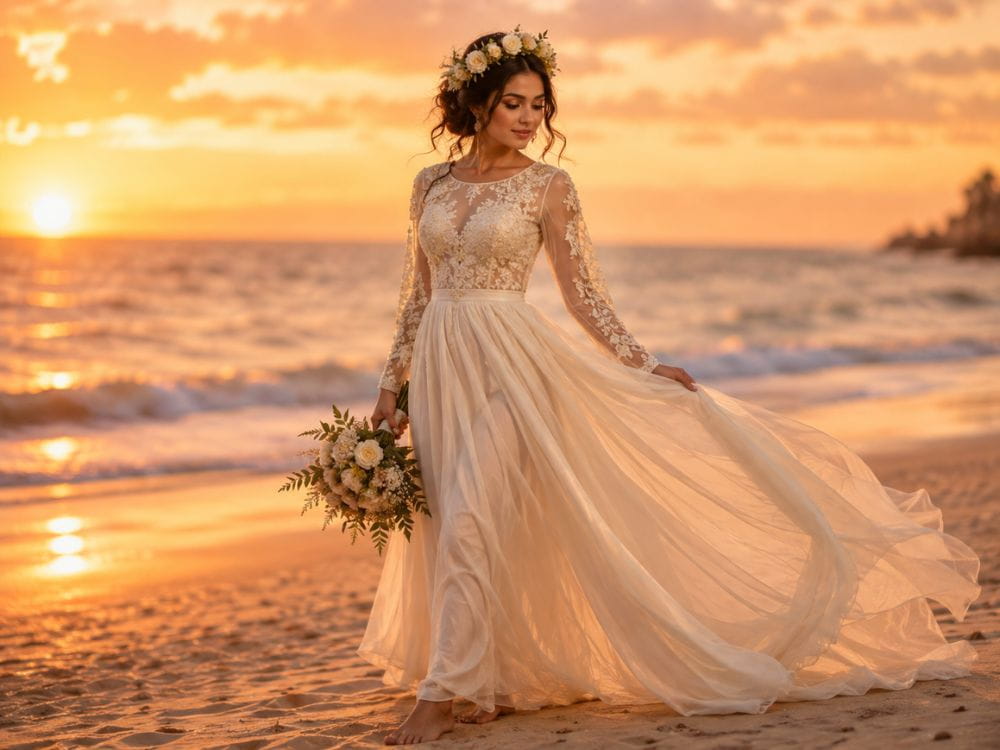
Destination weddings call for lighter fabrics and breezier silhouettes, and bridal AI fashion prompts need to reflect that shift to feel authentic. A beach or cliffside wedding rarely suits the same heavy embroidery and structured silhouettes that work for a palace ceremony, and prompts that ignore this contrast tend to produce outfits that look out of place against a sandy or coastal backdrop.
The goal here is movement — fabric that catches wind, hair that isn’t perfectly still, and lighting that feels like it was captured outdoors rather than in a studio.
How to Apply This Prompt
Swap heavy fabrics (velvet, silk brocade) for lightweight ones (chiffon, organza, linen) and always specify an outdoor natural setting. This keeps the AI from defaulting to indoor studio backdrops.
Regal Royal Bridal Portraits
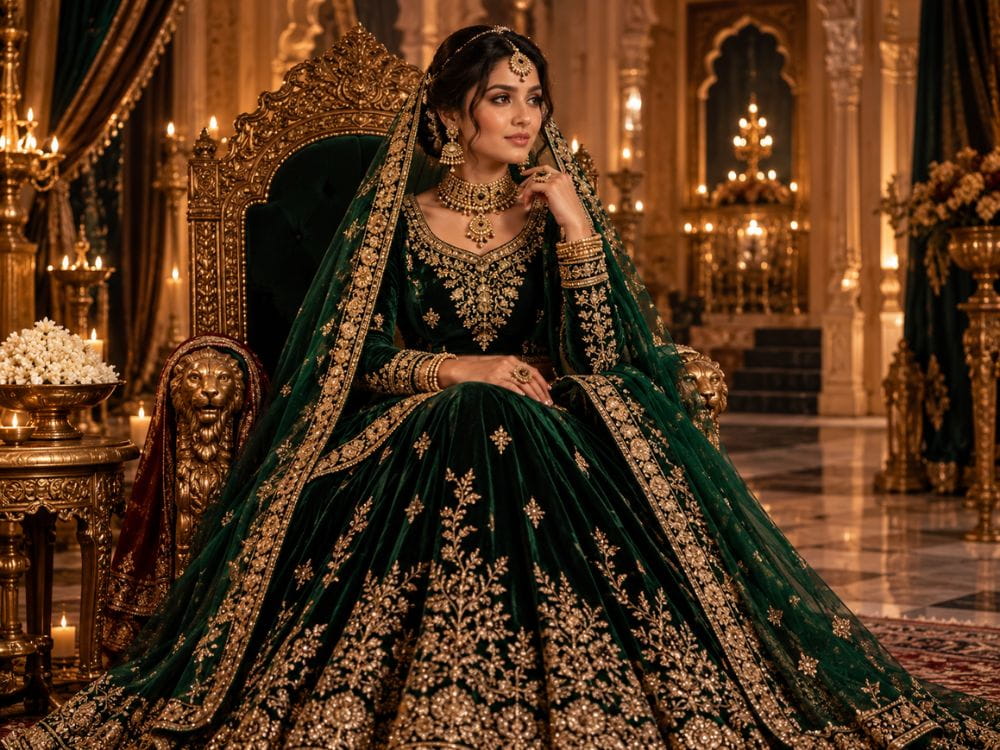
For brides who want drama and grandeur, royal-inspired bridal AI fashion prompts consistently produce the most striking, magazine-worthy results. This category performs particularly well with AI image generators because palace architecture, throne rooms, and ornate interiors are heavily represented in the training data these models have learned from.
That means the backgrounds tend to come out convincing with relatively little extra prompting. The real skill lies in balancing the grandeur of the setting with the bride herself, so she doesn’t get visually lost against an overly busy background.
How to Apply This Prompt
Add palace, throne, or heritage architecture to your setting description, and use words like “regal,” “opulent,” or “majestic” to push the AI toward richer color palettes and more elaborate detailing.
Minimalist & Boho Bridal Styles
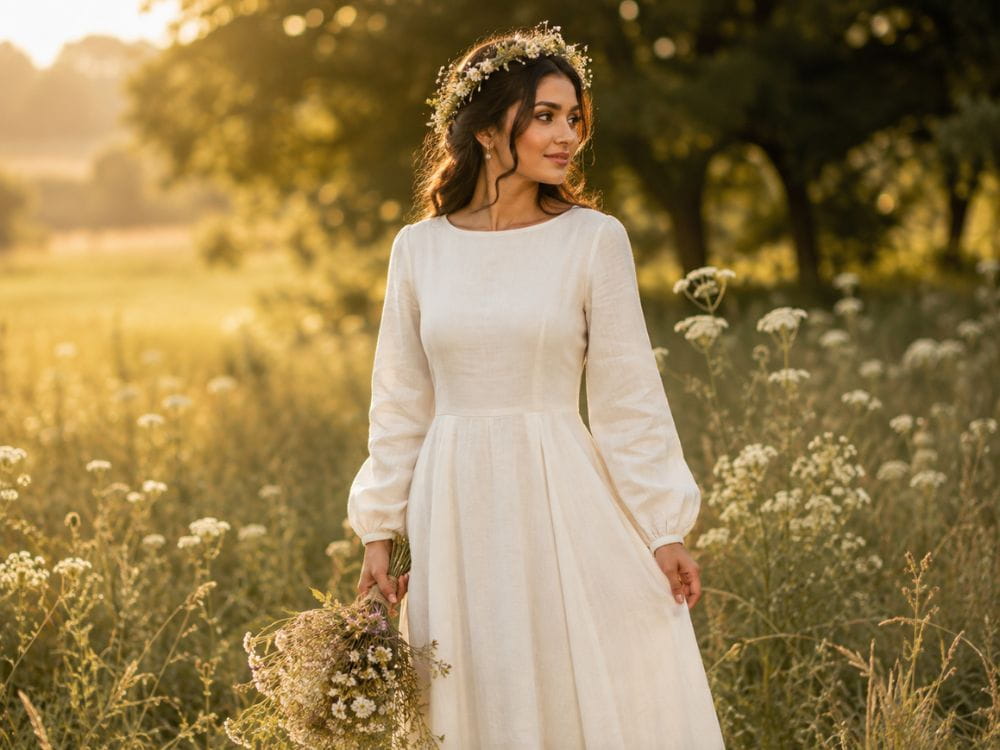
Not every bride wants heavy embellishment. Minimalist bridal AI fashion prompts require different vocabulary entirely, favoring texture and simplicity over embroidery. This is a category where AI image generators need more restraint from the prompt-writer, not less, because most bridal training data leans heavily toward ornate, embellished looks. Left to their own devices, many models will quietly add beading or embroidery even when you didn’t ask for it. Explicitly telling the AI what to leave out is just as important as telling it what to include.
How to Apply This Prompt
Use words like “clean lines,” “unadorned,” “natural texture,” and “soft neutral palette” instead of describing embroidery or embellishment. This is where AI tools can accidentally over-decorate if you’re not explicit about restraint.
Bridal Reception & Sangeet Outfits
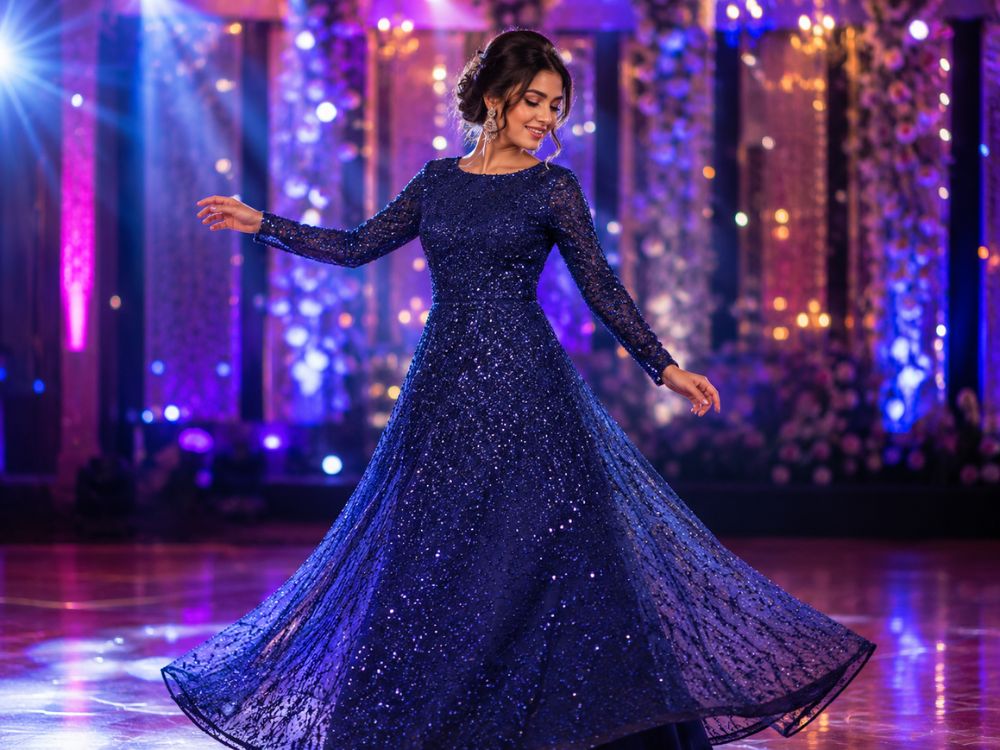
Reception and sangeet looks are typically bolder and more colorful than the main ceremony outfit, giving bridal AI fashion prompts room to experiment with vibrant palettes. These occasions are also where movement matters most — a sangeet outfit is meant to be danced in, not just posed in — so prompts that describe motion tend to produce far more energetic, believable results than static portrait-style requests.
How to Apply This Prompt
Push saturation and movement into the prompt with words like “sequin,” “shimmer,” “vibrant,” and describe dynamic poses (twirling, dancing) to get livelier, less static results.
Bridal Details & Accessories Prompts
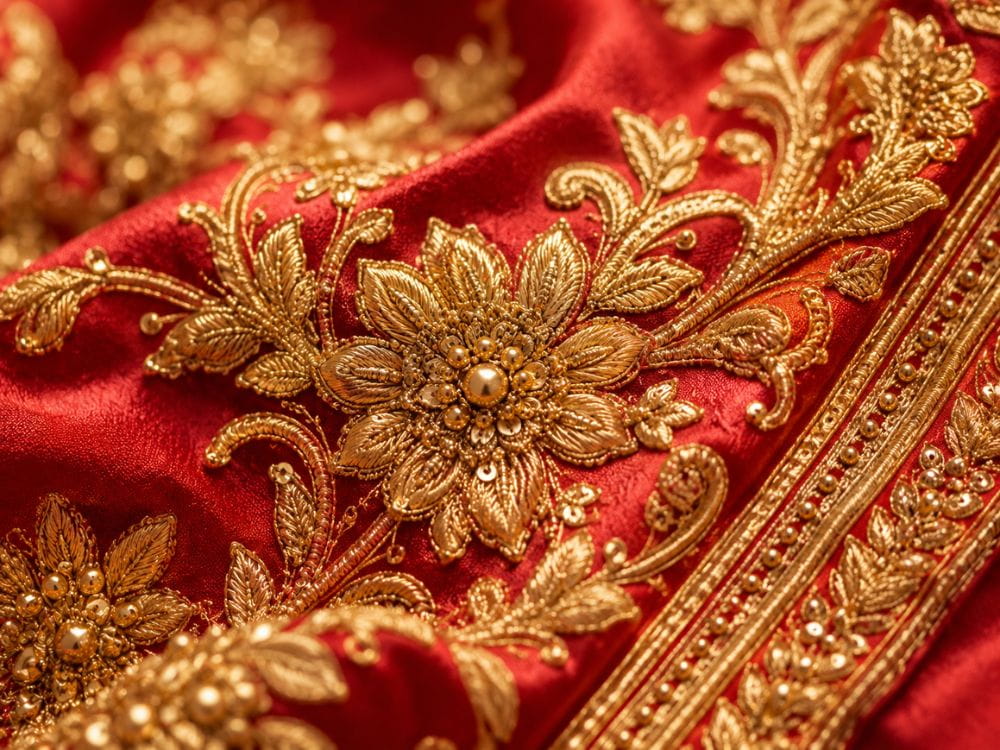
Sometimes the most useful bridal AI fashion prompts focus on details rather than a full outfit, especially for boutique marketing and product photography. Detail-focused bridal AI fashion prompts are also the easiest entry point for beginners, since a single close-up shot has far fewer variables to get wrong than a full-body portrait — no need to worry about pose, proportion, or full-garment draping, just the texture and lighting of one element.
How to Apply This Prompt
Zoom the prompt in with words like “close-up,” “macro detail,” or “product photography” and describe a single element (jewelry, embroidery, footwear) rather than the whole bridal look.
Common Mistakes to Avoid With Bridal AI Prompts
Even with a strong bridal AI fashion prompts formula, a few habits consistently produce weaker results:
- Being too vague. “Beautiful bride” gives the AI almost nothing to work with. Always specify garment, fabric, color, and setting.
- Overloading the prompt. Cramming ten adjectives into one sentence often confuses the model. Pick the three or four details that matter most.
- Ignoring lighting. Lighting changes mood more than almost any other variable. A “candlelit” bridal portrait and a “bright daylight” one can look like entirely different photoshoots.
- Forgetting cultural accuracy. If you want a specific regional style (Kanjeevaram, Banarasi, bandhani), name it directly rather than describing it generically.
- Not iterating. The first generation is rarely the final one. Treat each output as a draft you refine, not a finished product.
- Skipping the photography style reference. Prompts that name a style — editorial, documentary wedding photography, fine art portraiture — consistently outperform prompts that leave this out, because it gives the AI a compositional framework to follow instead of guessing.
- Using contradictory descriptors. Asking for a “minimalist, heavily embellished” look in the same prompt confuses the model and often produces a muddled result that satisfies neither direction. Pick one aesthetic and commit to it.
Choosing Between AI Tools for Bridal Prompts
Different AI image generators interpret the same bridal AI fashion prompt in noticeably different ways, and it’s worth testing a few before settling on one for a project. Midjourney tends to favor richer color grading and more cinematic composition, which suits regal and traditional bridal looks especially well.
DALL-E often produces cleaner, more literal interpretations of a prompt, which can be useful when you need the AI to follow very specific instructions without much creative deviation. Tools built on Stable Diffusion models sit somewhere in between and are often more customizable if you’re comfortable adjusting technical settings like sampling steps or guidance scale.
None of these is objectively “better” — the right choice depends on whether you want creative interpretation or precise control.
If you’re exploring other AI tools for fashion visualization, our guide on Midjourney Fashion Prompts breaks down platform-specific techniques, and our Best DALL-E Prompts for Fashion Design article covers a different rendering style worth comparing against Midjourney’s output. If you’re newer to prompt writing in general, start with How to Write AI Fashion Prompts for the fundamentals before jumping into bridal-specific work.
For readers who want to go deeper into the AI tools themselves, Midjourney’s official site and OpenAI’s DALL-E page are worth bookmarking, since both platforms update their rendering capabilities frequently and the best prompt techniques shift along with them.
FAQ: Bridal AI Fashion Prompts
1. What are bridal AI fashion prompts used for?
Bridal AI fashion prompts are text descriptions used with AI image generators like Midjourney or DALL-E to create wedding outfit concepts, mood boards, and design references without needing an illustrator or photoshoot.
2. Which AI tool works best for bridal fashion prompts?
Midjourney tends to produce the most photorealistic and editorial-style bridal images, while DALL-E is often easier for quick iterations and more literal interpretations of a prompt. Testing the same prompt across both is a common workflow for designers.
3. Can I use AI-generated bridal images commercially?
Usage rights depend on the specific AI platform’s terms of service, which vary and change over time, so it’s worth checking the current licensing terms of whichever tool you’re using before using outputs commercially.
4. How do I make bridal AI prompts look more realistic?
Add specific lighting terms (golden hour, soft studio light), reference a photography style (editorial, documentary), and avoid generic adjectives. Fabric and texture descriptions also significantly improve realism.
5. Do I need to know fashion terminology to write good prompts?
It helps, but it’s not required. Starting with the basic formula in this guide (garment, fabric, color, setting, lighting, mood) will get you most of the way there even without deep fashion vocabulary.
6. Can these prompts be adapted for non-Indian bridal styles?
Yes. Simply swap the traditional garment names and jewelry references with the relevant regional or cultural terms, and the underlying prompt structure still works — a Chinese qipao, a Nigerian aso-oke, or a Western ball gown all respond to the same garment-fabric-color-setting-lighting formula.
7. How many variations should I generate before picking a final design?
There’s no fixed number, but most designers find that three to five variations of the same prompt — changing only one variable at a time — is enough to spot a clear favorite. Generating dozens of near-identical images rarely adds new insight; it’s usually more useful to change the fabric, lighting, or setting between rounds rather than regenerating the exact same prompt repeatedly.
Have you tried any of these bridal AI fashion prompts? Save the ones that fit your style and experiment with small tweaks to the color, fabric, or setting to make each result your own — and if you’re building out a full bridal lookbook, pair a few prompts from different categories in this guide (a traditional saree alongside a fusion reception look, for instance) to show range in a single client presentation.