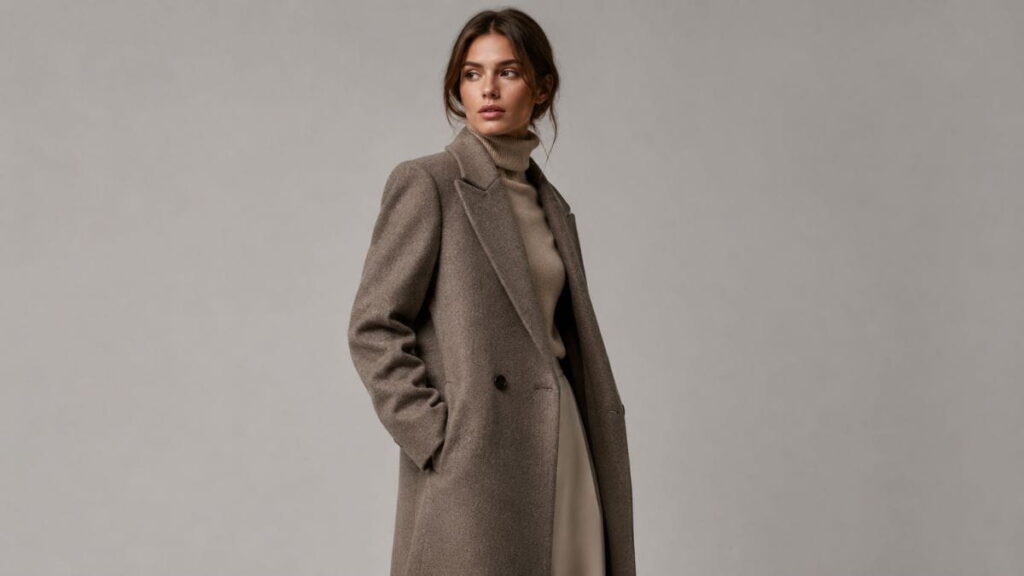
Best DALL-E prompts for fashion design don’t look like the prompts you’d use for a landscape painting or a sci-fi movie poster, and that’s the mistake most designers make on their first try. They type something like “a beautiful dress” into DALL-E, get back a generic gown that could belong in any decade, any brand, any collection, and conclude the tool “just isn’t good for fashion.” It isn’t the tool. It’s the prompt.
I’ve spent the last several months running the same fashion briefs through DALL-E, Midjourney, and Stable Diffusion to figure out where each one actually earns its keep, and DALL-E has a very specific sweet spot: fast concept boards, editable iterations through conversation, and garment construction details that hold up under scrutiny. This guide breaks down exactly how to talk to it so your outputs look like they came from a design studio, not a stock photo site.
If you’re just getting started, explore our AI Fashion Prompts collection for beginner-friendly prompt ideas covering runway, editorial, streetwear, and luxury fashion.
Why Fashion Designers Are Choosing DALL-E (and When They Shouldn’t)
Fashion designers reach for DALL-E, built by OpenAI, for one main reason: it lives inside a conversation. You can describe a jacket, look at the result, and say “keep the silhouette but change the sleeve to raglan” in plain English, and it understands you. That back-and-forth is closer to briefing a junior designer than operating software, which is exactly why the best DALL-E prompts for fashion design tend to read like directions you’d give a person, not keywords you’d feed a search engine.
That said, DALL-E isn’t the right tool for everything. If you need hyper-photorealistic editorial images with dramatic, painterly lighting, Midjourney usually wins. If you need total control over a repeatable style across a full collection, Stable Diffusion’s fine-tuning options give you more precision. DALL-E’s advantage is speed, coherence, and ease of iteration — which makes it ideal for early-stage concept development, mood boards, and pitching ideas before a single pattern is cut.
DALL-E vs Midjourney vs Stable Diffusion for Fashion Work
Before you commit to one AI image generator for your entire design process, it helps to see how the best DALL-E prompts for fashion design actually stack up against the alternatives, side by side.
| Feature | DALL-E | Midjourney | Stable Diffusion |
| Best for | Concept iteration, quick mockups | Editorial-quality imagery | Custom-trained brand styles |
| Prompt style | Natural, conversational | Keyword-heavy, artistic | Technical, parameter-driven |
| Learning curve | Low | Medium | High |
| Fabric/texture accuracy | Strong | Very strong | Strong (with training) |
| Iteration speed | Fast (chat-based) | Moderate | Slow (requires re-render) |
| Cost of entry | Included with ChatGPT Plus | Subscription-only | Free, but needs setup |
This isn’t a case of one tool beating the others outright. Designers moving fast in the early sketch phase tend to pick DALL-E prompts for fashion design specifically because the interface removes friction. Once a concept is locked, some teams export it into Midjourney for hero images or into Stable Diffusion for a custom-trained house style. Knowing where DALL-E fits in that pipeline is half the battle — the other half is knowing the best DALL-E prompts for fashion design well enough to use them correctly, which is what the rest of this guide covers.
Hack #1: Anchor Every Prompt to a Garment Category
The single biggest reason the best DALL-E prompts for fashion design come back looking vague otherwise is that the prompt never specifies what kind of garment it’s actually generating. “A stylish outfit” gives the model almost nothing to work with. “A tailored wool overcoat with a notched lapel” gives it a category, a material, and a construction detail in one sentence.
How to Apply It
Start every prompt with the garment type stated plainly — trench coat, wrap dress, cargo trousers, bomber jacket — before you add any styling language. Think of this as the noun your whole sentence is built around. A useful template looks like this:
“A [garment type] made of [fabric], designed for [season/occasion], photographed on a mannequin against a plain studio background.”
For example: “A cropped denim jacket made of raw selvedge denim, designed for early autumn, photographed on a mannequin against a plain studio background.” This single change — naming the garment category first — consistently produces sharper, more usable results than open-ended styling prompts, and it’s the foundation every other hack in this list of best DALL-E prompts for fashion design builds on.
Hack #2: Name the Fabric, Not Just the Color
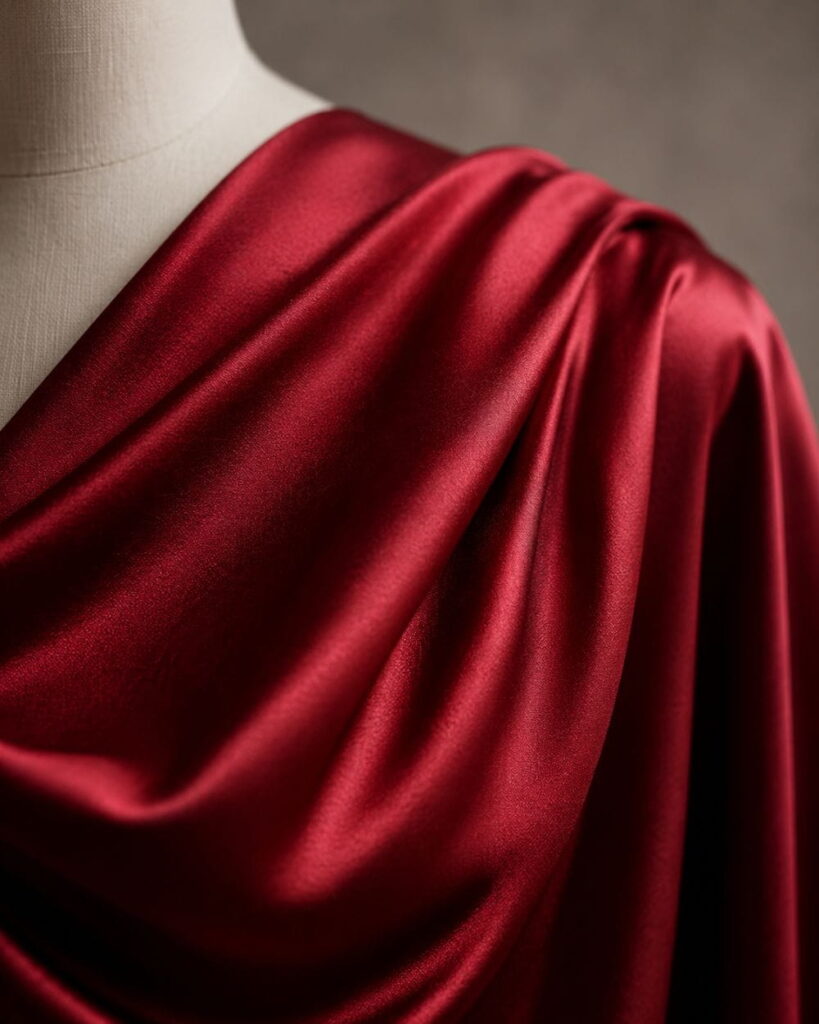
“A red dress” tells DALL-E almost nothing about texture, drape, or how light should behave on the surface. “A crimson silk charmeuse dress” tells it everything: sheen, weight, and how the fabric will fall. Fabric names carry an enormous amount of implicit visual information, and skipping them is one of the most common reasons even otherwise-solid DALL-E prompts for fashion design still look “flat” or generic. Naming fabric correctly is what separates the best DALL-E prompts for fashion design from ones that only describe color and cut.
How to Apply It
Keep a running list of fabric names you actually use in your work — chiffon, boucle, ponte knit, waxed cotton, herringbone tweed, ribbed jersey — and drop the specific one into every prompt instead of a general texture word like “soft” or “smooth.” If you’re not sure which fabric name matches the look you want, describe how it should move: “a fabric with a heavy drape that pools at the hem” gets you most of the way there even without the technical term, and DALL-E will usually infer something close to wool crepe or heavy silk.
Hack #3: Borrow Language From Technical Fashion Sketches
Fashion school teaches a specific vocabulary — princess seams, empire waist, dolman sleeve, dart placement, bias cut — and that vocabulary is exactly what separates a generic AI dress from one that reads as professionally designed. DALL-E has been trained on enough fashion imagery and captioned data that it recognizes this terminology and responds to it with far more construction accuracy than casual language.
How to Apply It
Before you prompt, jot down two or three technical terms that describe the construction you’re picturing, not just the overall vibe. Instead of “a flowy dress,” try “an A-line dress with a bias-cut skirt and a fitted empire waist.” Instead of “a cool jacket,” try “a cropped jacket with structured shoulders and a peplum hem.” This is one of the fastest ways to move from stock-photo-generic to studio-sketch-specific, and it costs you nothing but a slightly longer sentence — which is exactly the trade-off behind most of the best DALL-E prompts for fashion design.
Hack #4: Specify the Era or Runway Reference
One trait shared by nearly all of the best DALL-E prompts for fashion design is a clear era or aesthetic reference. Fashion is deeply referential, and DALL-E understands era and movement language surprisingly well. Naming a decade, a design movement, or a runway aesthetic gives the model a whole visual language to pull from in one phrase, which is far more efficient than trying to describe every detail of that aesthetic yourself.
How to Apply It
Add a short era or style reference toward the end of your prompt: “in the style of 1970s French tailoring,” “with a 90s minimalist silhouette,” or “inspired by modern Scandinavian streetwear.” Be careful here — avoid naming living designers or specific protected brands, since DALL-E will often decline those requests or produce inconsistent results, and it raises obvious intellectual property concerns for anything you plan to publish or sell. Stick to eras, movements, and general aesthetic descriptors like “utilitarian,” “romantic maximalism,” or “brutalist minimalism” instead.
Looking for inspiration? Browse our Luxury Fashion Prompts and Runway Fashion Prompts collections to discover high-fashion styling ideas you can adapt for DALL-E.
Hack #5: Control the Silhouette With Body Position
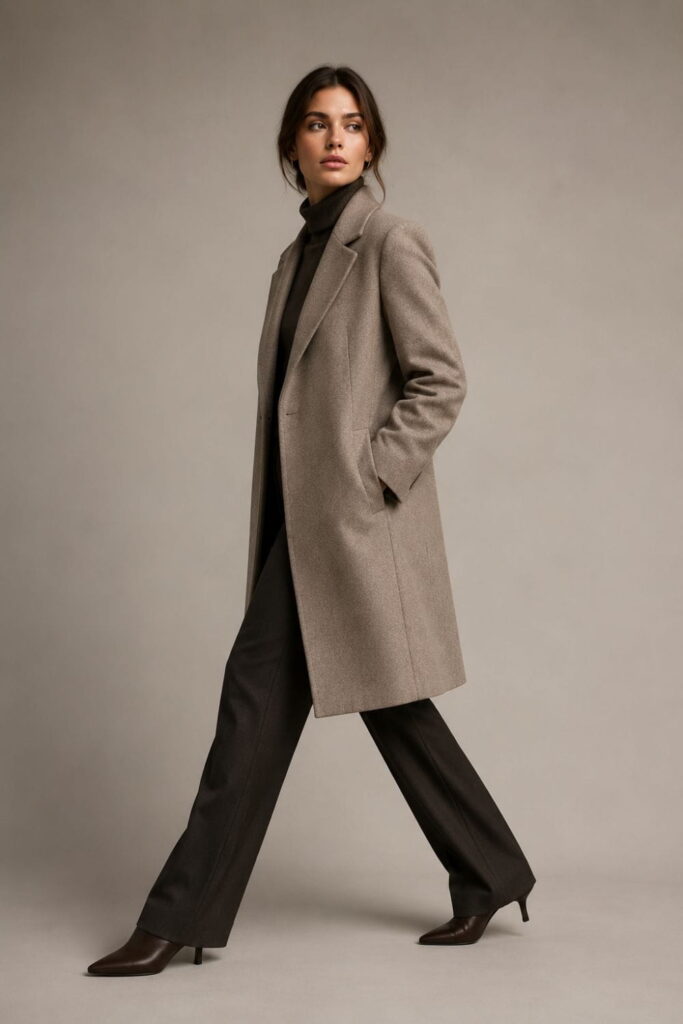
A garment reads completely differently depending on how the body wearing it is posed, and this is one of the more overlooked levers in the best DALL-E prompts for fashion design. A coat shot with arms crossed hides the silhouette; the same coat shot mid-stride with one hand in a pocket reveals drape, movement, and proportion.
How to Apply It
Add a short pose instruction after your garment description: “model walking, one hand in pocket,” “model standing with weight on one hip,” or “three-quarter turn showing the back seam.” If you need to check construction details like a back zipper, a yoke seam, or a hidden placket, explicitly ask for a rear or side angle — DALL-E will usually comply, and this single addition solves a huge portion of “why can’t I see the back of the garment” complaints designers run into.
Hack #6: Layer in Lighting Like a Photo Shoot
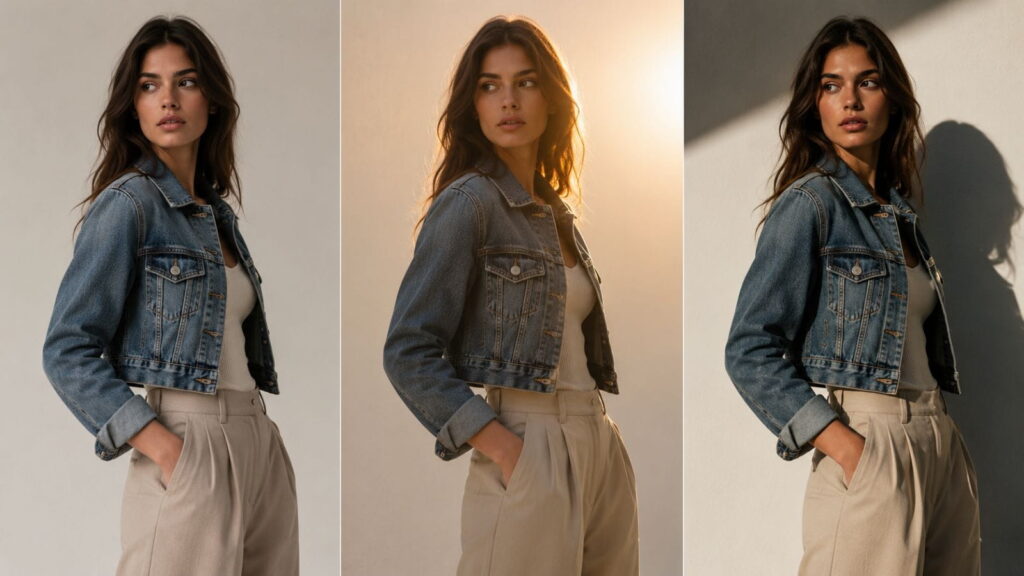
Lighting does more to sell a fashion image than almost any other variable, which is why lighting language shows up in nearly every one of the best DALL-E prompts for fashion design covered in this guide. It’s one of the areas where DALL-E genuinely shines compared to some competitors, especially for softer, commercial-style lighting setups.
How to Apply It
Borrow lighting language directly from photography briefs: “soft diffused studio lighting,” “golden hour backlighting,” “high-contrast editorial lighting with hard shadows,” or “even ring-light lighting for e-commerce.” Pair the lighting instruction with the background: a plain seamless backdrop for catalog-style shots, or an outdoor urban setting for lifestyle imagery. Changing only the lighting description on an otherwise identical prompt is a great way to generate a whole set of usable variations from a single concept.
Lighting plays a huge role in realism. Our Fashion Photography Prompts guide includes additional lighting techniques for editorial-quality AI images.
Hack #7: Use Negative Space Deliberately
Most fashion prompts focus entirely on what should appear in the image and forget to manage what surrounds it — a detail the best DALL-E prompts for fashion design never skip. Cluttered backgrounds compete with the garment for attention and make it harder to use the output for actual design decisions or client presentations.
How to Apply It
Explicitly describe the background and its emptiness: “against a seamless white studio background with no props,” or “on a plain grey backdrop, no other elements in frame.” If you want the garment to be the only visual focus — which is almost always the goal for concept work — this instruction matters more than people expect, and it’s an easy line to forget when you’re focused on describing the clothing itself.
If your goal is magazine-quality compositions, you’ll also enjoy our Editorial Fashion Prompts collection.
Hack #8: Iterate Conversationally Instead of Rewriting
This is where DALL-E genuinely separates itself from prompt-only tools. Because it operates inside a chat interface, you don’t need to rebuild your entire prompt from scratch every time you want a small change. You can simply respond to the image the way you’d respond to a colleague’s sketch.
How to Apply It
After your first generation, give short, specific feedback instead of a whole new prompt: “keep everything the same but change the sleeve length to three-quarter,” or “same jacket, switch the fabric to a herringbone tweed,” or “same pose, change the background to outdoors.” This conversational iteration is arguably the most underused feature among the best DALL-E prompts for fashion design, and it’s the fastest way to go from one idea to a full range of variations without losing the details you already liked.
Hack #9: Prompt for Flat Sketches Separately From Renders
Designers sometimes make the mistake of asking for a photorealistic render and a technical flat sketch in the same prompt, which confuses the model and produces a muddled result. These are two different jobs and deserve two different prompts.
How to Apply It
For a technical flat, explicitly ask for it: “a flat technical fashion sketch of a bomber jacket, front and back view, line drawing style, no model, on a white background.” For a photorealistic render, describe it as a photograph: “a photorealistic studio photograph of the same bomber jacket worn by a model.” Running both prompts back to back gives you a technical reference and a presentation-ready image from the same core concept, which is exactly what most design decks actually need — and it’s a distinction the best DALL-E prompts for fashion design always respect.
Hack #10: Build a Prompt Formula You Can Reuse
Once you’ve tested a handful of these hacks, the real efficiency gain comes from turning the best DALL-E prompts for fashion design into a repeatable formula rather than reinventing your prompt every single time.
How to Apply It
A dependable formula for fashion design prompts looks like this:
“A [garment type] made of [fabric], with [construction detail], in the style of [era/aesthetic reference], on a model [pose description], with [lighting style], against [background description].”
Save this as a template and swap out the bracketed sections for each new concept. This is the fastest route to consistent, professional-looking output, and it’s the exact structure behind most of the best DALL-E prompts for fashion design that circulate among working designers, even if they never write it down as a formula.
Hack #11: Combine DALL-E Output With Real Fabric Swatches
The final entry on this list of the best DALL-E prompts for fashion design isn’t really a prompt trick at all — it’s a workflow trick. AI-generated fabric texture is good, but it’s still an approximation. The strongest fashion concept boards combine a DALL-E render for silhouette and styling with a real, physical fabric swatch photographed separately for texture accuracy.
How to Apply It
Generate your silhouette and styling concept in DALL-E using the earlier hacks, then photograph or scan the actual fabric swatch you’re considering and place them side by side in your concept deck or, if you need a starting point, one of the moodboard tools for fashion designers covered in our related guide. This hybrid approach is common practice among design studios that use AI for ideation but still rely on physical materials for final fabric decisions — a workflow echoed in reporting from Vogue Business on how AI tools are being folded into existing design pipelines rather than replacing them outright.
Ready-to-Use DALL-E Prompt Examples for Fashion Design
Reading about technique is useful, but nothing beats seeing the best DALL-E prompts for fashion design applied in full. Below are six complete prompts, each built from the hacks above, that you can copy, paste, and adapt for your own concepts. These are deliberately written as full sentences rather than keyword strings, because that’s the input style DALL-E responds to best.
- Outerwear: “A cropped puffer jacket made of matte technical nylon, with contrast topstitching along the seams, in the style of 90s streetwear, on a model walking with hands in pockets, under soft diffused studio lighting, against a seamless light-grey background.”
- Evening wear: “A floor-length gown made of crimson silk charmeuse, with a bias-cut skirt and a fitted bodice, inspired by 1970s red-carpet glamour, on a model in a three-quarter turn, under warm golden-hour lighting, against a plain black backdrop.”
- Workwear: “A tailored wool blazer made of herringbone tweed, with structured shoulders and a single-button closure, in a modern utilitarian aesthetic, on a model standing with weight on one hip, under even studio lighting, against a plain white background.”
- Knitwear: “An oversized turtleneck sweater made of chunky ribbed wool knit, with dropped shoulders, inspired by Scandinavian minimalism, on a model seated with hands folded, under soft natural window lighting, against a neutral beige backdrop.”
- Denim: “A cropped denim jacket made of raw selvedge denim, with exposed chain-stitch hemming, in an early-autumn streetwear style, on a model with one hand raised adjusting the collar, under high-contrast editorial lighting, against a muted urban brick wall.”
- Technical flat sketch: “A flat technical fashion sketch of a trench coat, front and back view, line drawing style with construction seams labeled, no model, on a plain white background.”
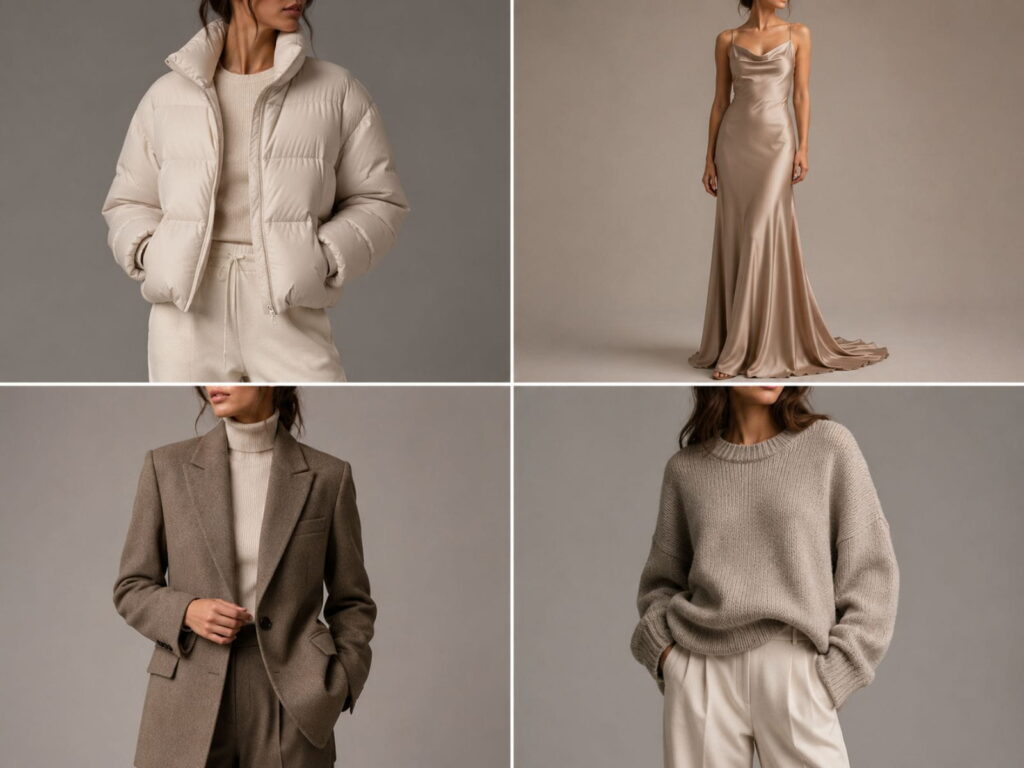
Notice that each prompt follows the same underlying skeleton from Hack #10, with only the bracketed details swapped out. Once you’ve run a handful of your own prompts through this structure, you’ll start to develop an intuition for which details matter most for your particular aesthetic, and you can drop or add elements accordingly.
Common Mistakes to Avoid When Prompting DALL-E for Fashion
Even designers who understand the best DALL-E prompts for fashion design in theory sometimes trip over a handful of avoidable mistakes in practice. Watching out for these will save you several wasted generations.
Overloading a single prompt. Trying to specify garment, fabric, era, pose, lighting, background, and a second garment all in one sentence tends to confuse the model rather than help it — even the best DALL-E prompts for fashion design stay focused on one primary garment at a time. Build supporting looks separately.
Forgetting the camera angle. If you need to check a back seam, a hidden zipper, or a yoke detail, say so explicitly, since the best DALL-E prompts for fashion design always specify an angle. DALL-E defaults to a flattering front-facing angle unless you ask for something else.
Naming real designers or protected brand names. Beyond the fact that DALL-E will often decline or produce inconsistent results, using a living designer’s name or a trademarked brand in a prompt creates real intellectual property risk if the output is ever published or sold. Stick to era and aesthetic language instead, as covered in Hack #4.
Treating every generation as final. The conversational iteration described in Hack #8 exists precisely because your first output is rarely your best one. Treat each generation as a draft you refine, not a finished asset.
Ignoring fabric physics. A “flowing silk dress” and a “structured cotton dress” move completely differently, and DALL-E generally respects that distinction if you name the fabric. Skipping the fabric name is one of the most common reasons an otherwise good prompt still doesn’t read as one of the best DALL-E prompts for fashion design—it just looks generic instead.
Turning Your Best DALL-E Prompts Into a Full Fashion Moodboard
A single strong image rarely tells the whole story of a collection. Once you’ve found the best DALL-E prompts for fashion design that work for your aesthetic—using the garment, fabric, era, pose, lighting, and background structure from Hack #10 — the next step is generating a coherent set of images that can sit together on one moodboard without looking like they came from five different designers.
The trick is to lock down every variable except one between generations. If you’re building a five-piece capsule collection, keep the fabric family, lighting style, and background identical across all five prompts, and only change the garment type and construction detail. This is exactly how design teams keep a DALL-E-assisted moodboard looking like a single cohesive vision rather than a grab bag of unrelated AI images.
A practical workflow looks like this:
- Pick one lighting style and one background type for the entire collection, and reuse that exact phrasing in every prompt.
- Choose two or three fabrics that make sense together — say, a heavy wool, a matching ribbed knit, and a complementary leather trim — and rotate through them across the pieces.
- Vary only the garment type and construction detail between prompts: a coat, then a matching trouser, then a knit layering piece.
- Use the conversational iteration from Hack #8 to nudge each piece toward the same aesthetic once you see the first couple of results.
- Export the final set into your moodboard tool of choice. You can also explore our Fashion Moodboard Tools guide to discover platforms for organizing AI-generated fashion concepts into professional presentation boards, alongside real fabric swatches as described in Hack #11, so stakeholders see both the AI concept and the physical material side by side.
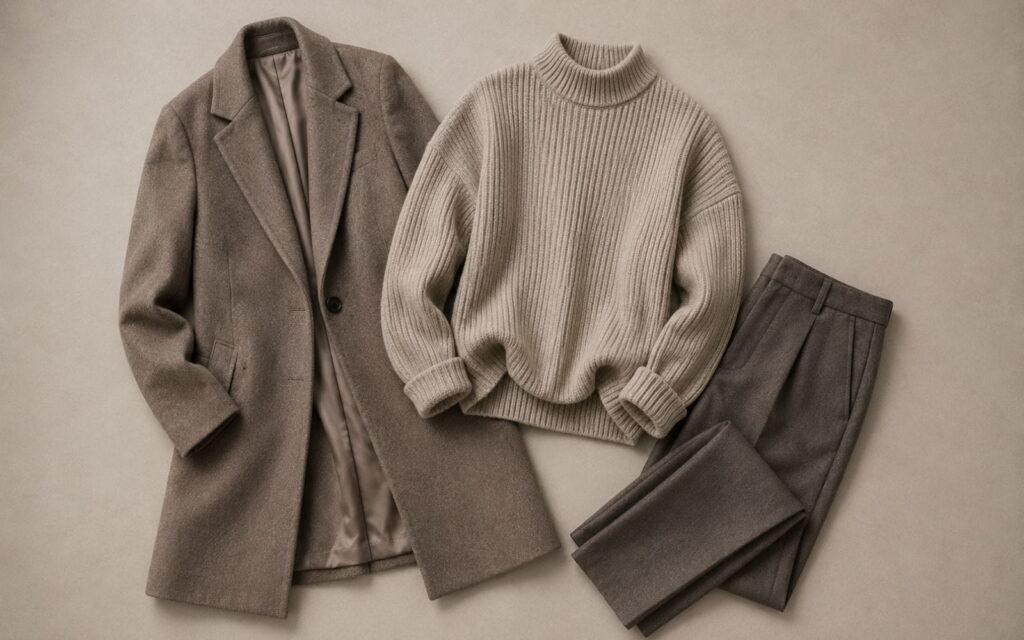
Design teams who skip this locking-down step often end up with technically impressive individual images that don’t read as a collection at all — each piece feels like it was designed in isolation because, in a sense, it was. Treating your prompt formula as a style guide rather than a one-off recipe is what separates a scattered set of AI experiments from a Fashion a creative director would actually sign off on — and it’s the difference between using thebest DALL-E prompts for fashion design once and building them into an actual repeatable process.
FAQ: Best DALL-E Prompts for Fashion Design
What are the best DALL-E prompts for fashion design if I’m a total beginner?
tart with the simple formula from Hack #10: garment type, fabric, construction detail, era or aesthetic reference, pose, lighting, and background. That formula is the fastest shortcut to the best DALL-E prompts for fashion design without memorizing every hack individually. You don’t need every element in your first attempt — even just naming the garment and fabric correctly (Hacks #1 and #2) will noticeably improve your results over a generic prompt.
Can DALL-E generate a full fashion collection, not just single pieces?
Yes, though it works best when you generate pieces individually using a consistent prompt formula and the same styling language across each one, then assemble them into a collection afterward. Trying to generate an entire multi-piece collection in a single prompt usually produces inconsistent results.
Is DALL-E better than Midjourney for fashion design?
It depends on the stage of your process. The best DALL-E prompts for fashion design tend to be faster for early concept work and easier to iterate on conversationally, while Midjourney often produces more dramatic, editorial-quality final imagery. Many designers use both at different stages, as outlined in the comparison table earlier in this guide.
Do I need to mention specific fabric names for good results?
Not strictly, but it helps significantly, and it’s a defining trait of the best DALL-E prompts for fashion design. Naming an actual fabric — silk crepe, waxed cotton, ribbed knit — gives DALL-E far more visual information than a general texture word like “soft” or “shiny,” and it’s one of the quickest ways to make an image look intentional rather than generic.
Can I use DALL-E fashion images commercially?
Usage rights depend on OpenAI’s current terms of service, which have changed over time, so it’s worth checking the official OpenAI usage policies before using generated images in a commercial collection, marketing material, or paid client deliverable.
Why do my DALL-E fashion prompts keep producing generic-looking clothes?
This almost always comes down to missing specificity in one of three places: garment category, fabric name, or construction detail. Going back through Hacks #1 through #3 and adding just one specific term to each of those categories usually fixes the issue immediately — it’s the fastest route back to something that actually qualifies as one of the best DALL-E prompts for fashion design.
How long should a good DALL-E fashion prompt be?
There’s no strict word count, but most of the best DALL-E prompts for fashion design in this guide run one to two sentences long. Short enough to stay focused on a single garment, long enough to cover fabric, construction, pose, and lighting. If you’re consistently under 20 words, you’re probably leaving out details that matter.
Should I use DALL-E for final client presentations or only early concepts?
Both, depending on how the images are finished. Many studios use DALL-E renders as-is for early-stage pitches and internal concept reviews, then pair the strongest concepts with real fabric swatches and traditional technical flats (see Hack #11) before a final client presentation. Treating DALL-E as the first step in the process, rather than the last, tends to produce the most professional results.
Final Thoughts
Continue expanding your prompt library with our Streetwear Fashion Prompts, Luxury Fashion Prompts, and AI Fashion Prompts collections to create a wider range of fashion concepts.
The best DALL-E prompts for fashion design aren’t longer or more complicated than everyone else’s — that’s a distinction worth repeating one last time — they’re just more specific in the places that actually matter: garment category, fabric, construction, pose, and lighting. Treat your prompt like a design brief instead of a caption, lean on the conversational iteration DALL-E offers over other tools, and you’ll find the gap between “AI-generated” and “studio-quality concept board” closes a lot faster than expected.
If you’re building out a full AI-assisted design workflow, it’s also worth reading our related breakdown of prompt engineering fundamentals and our guide to moodboard tools for fashion designers for the steps that come before and after the prompting stage covered here.