
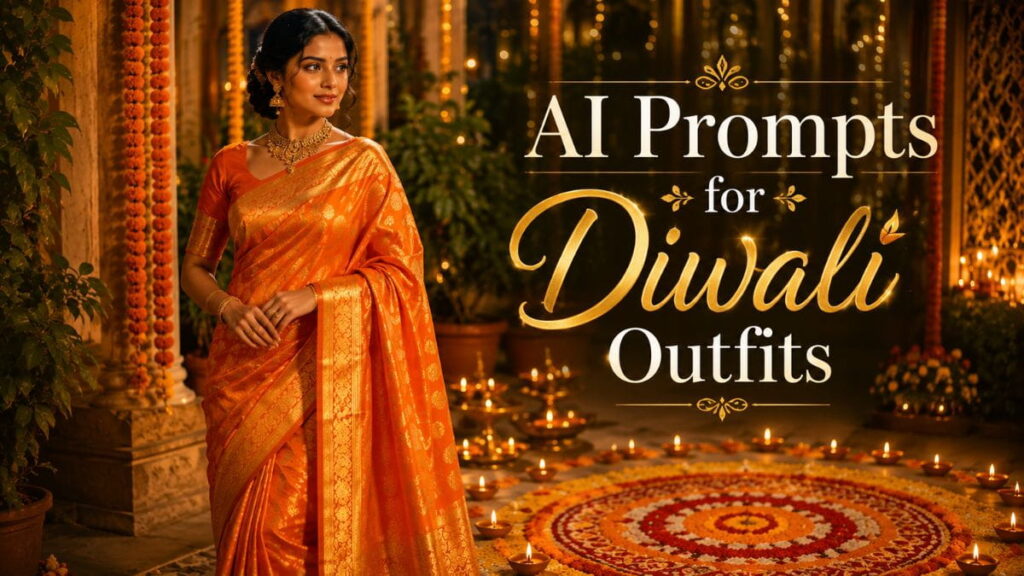
AI prompts for Diwali outfits are the fastest way to visualize a festive look before you ever step into a boutique. Instead of scrolling through hundreds of saved Instagram posts, you can type a few precise words into Midjourney or DALL-E and see a full festive outfit concept in seconds.
This guide gives you 30 ready-to-use AI prompts for Diwali outfits, organized by category — sarees, lehengas, menswear, fusion looks, and accessories. Copy any prompt, tweak the color or fabric, and generate.
Whether you’re a boutique owner prepping a festive lookbook, a content creator planning Diwali posts, or someone just curious what a color combination might look like before buying fabric, these prompts are written to work straight out of the box.
Why AI Prompts for Diwali Outfits Are So Useful
Diwali outfit planning used to mean weeks of shop-hopping before the festival rush hit. Now, AI prompts for Diwali outfits let designers and shoppers preview a look in the time it takes to type a sentence.
For boutique owners, this means showing clients three festive color options before committing to fabric. For content creators, it means a steady stream of festive lookbook content without a studio shoot.
The trick is specificity. A vague prompt like “Diwali outfit” gives you something generic. The 30 prompts below are built with enough detail — fabric, color, setting, lighting — to produce results worth saving.
There’s also a timing advantage that matters more for Diwali than for most other shoots. Festive shopping and boutique orders tend to spike in the two to three weeks before the festival, which leaves designers very little room to experiment once the season actually starts. Using AI prompts for Diwali outfits earlier in the year—to test palettes, silhouettes, and combinations—means the real production time later can go entirely into stitching and fittings instead of concept work.
None of this replaces a real tailor or a real photoshoot. What AI prompts for Diwali outfits replace is the guesswork that used to happen before either step.
There’s a practical business side to this too. Boutique owners who use AI prompts for Diwali outfits during client consultations report faster decisions, since a customer who sees three color directions side by side commits faster than one working from swatches alone.
Designers use the same prompts to stress-test a festive silhouette before cutting fabric. Content creators use them to keep a steady stream of festive lookbook posts flowing without booking a studio every week during the busy pre-Diwali season.
Think of AI prompts for Diwali outfits as the sketching phase of festive fashion, compressed from days into minutes. The final stitching and styling still need a human hand — the AI just removes the blank-page problem at the start.
How to Write AI Prompts for Diwali Outfits That Work
Every strong prompt in this guide follows the same loose formula:
Subject + Garment + Fabric + Color + Setting + Lighting + Mood + Style reference
For example, instead of “festive lehenga,” a stronger prompt reads: “A woman wearing a marigold-orange silk lehenga with gold zari border, standing near diya lamps and rangoli, warm evening lighting, festive editorial photography style.”
Each added detail changes the output. Fabric tells the AI texture. Setting tells it background. Lighting tells it mood.
Keep these tips in mind as you use the prompts below:
- Name the fabric. Silk, georgette, velvet, and brocade all render differently.
- Add festival cues. Diyas, rangoli, marigold flowers, and fairy lights instantly signal “Diwali” to the AI.
- Use a lighting cue. “Warm evening light” and “candlelit” both push the mood toward festive and cosy.
- Reference a photography style like editorial or documentary for more polished results.
- Iterate one variable at a time. Change the colour or setting rather than rewriting the whole prompt.
Writing AI prompts for Diwali outfits gets easier with practice. Save the wordings that worked well so you can reuse the formula for other festivals too.
It helps to treat each prompt like a short creative brief rather than a search query. A search query asks a system to find something that already exists. A prompt asks it to build something new from scratch.
The more context you give the AI, the closer the output lands to what you pictured. If you’re typing three or four words and hoping for the best, stop and ask what a stylist would need to know first — fabric, colour, occasion, mood, and setting are almost always the answer.
Keep a running note of prompts that produced results you liked, along with which tool you used. Over time this becomes a personal style guide you can reuse for every festive season, not just Diwali.
Now, let’s get into the prompts.
Diwali Saree & Traditional Drape Prompts
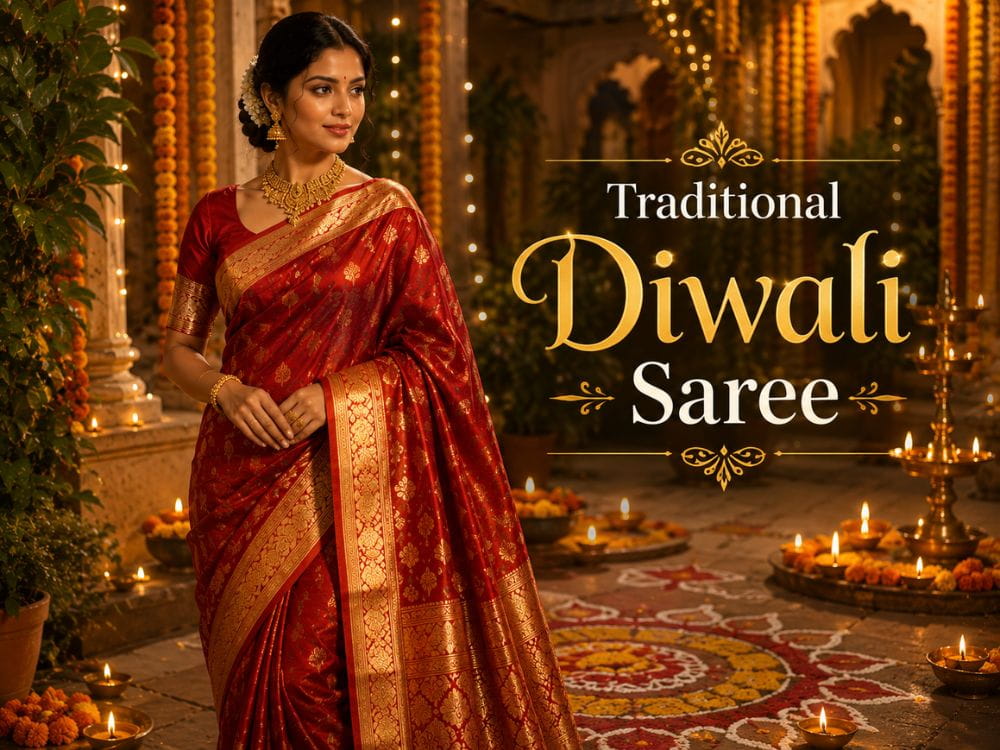
Sarees remain the most requested Diwali look, and AI tools handle them well once you name the fabric and region.
This category benefits from decades of saree photography and film costuming that AI models have learned from. Naming a specific weave – Banarasi, Kanjeevaram, or Paithani – pulls the AI toward accurate texture and border patterns instead of a generic drape.
How to Apply This Prompt
Start with the base formula, then add region-specific textile names (Banarasi, Kanjeevaram, Paithani) for more accurate results.
Festive Lehenga & Ghagra Prompts
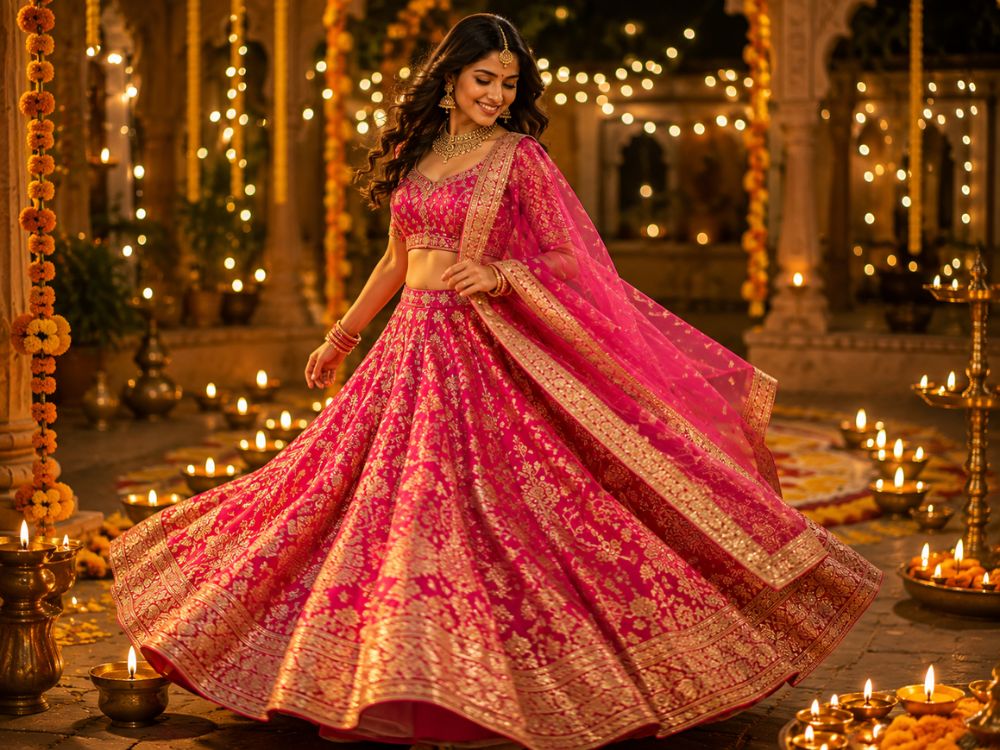
Lehengas bring more color and movement into a Diwali shoot, and AI models respond well to bold festive palettes here.
Because Diwali outfits are meant to be worn while dancing, lighting diyas, and moving through a decorated space, prompts that describe motion – twirling, walking, and dancing – consistently outperform static portrait requests in this category.
How to Apply This Prompt
Describe the skirt movement (twirling, flared) alongside the fabric to get livelier, less static results.
Men’s Kurta & Sherwani Prompts
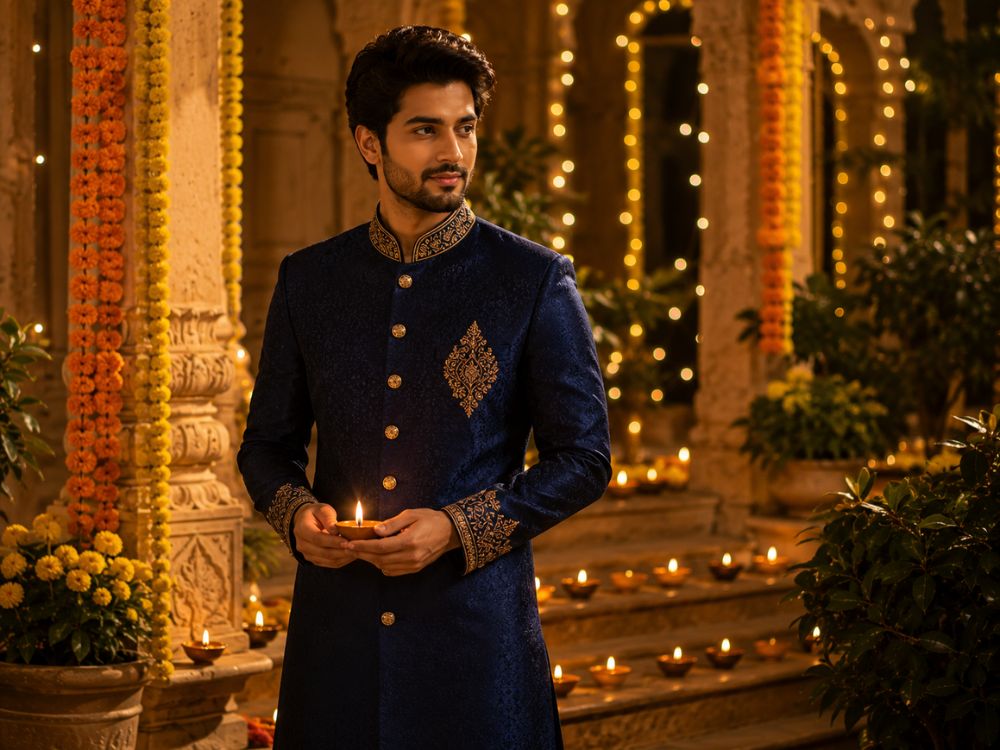
Menswear is often overlooked in festive prompt guides, but AI prompts for Diwali outfits work just as well for kurtas and sherwanis.
The same formula applies, but collar and jacket details carry more visual weight here than fabric alone. A Nehru collar versus a band collar changes the entire silhouette, so naming it precisely matters more than it does for draped garments.
How to Apply This Prompt
Name the collar style (Nehru collar, band collar) and fabric together, since these details change the silhouette the most.
Fusion Festive Wear Prompts
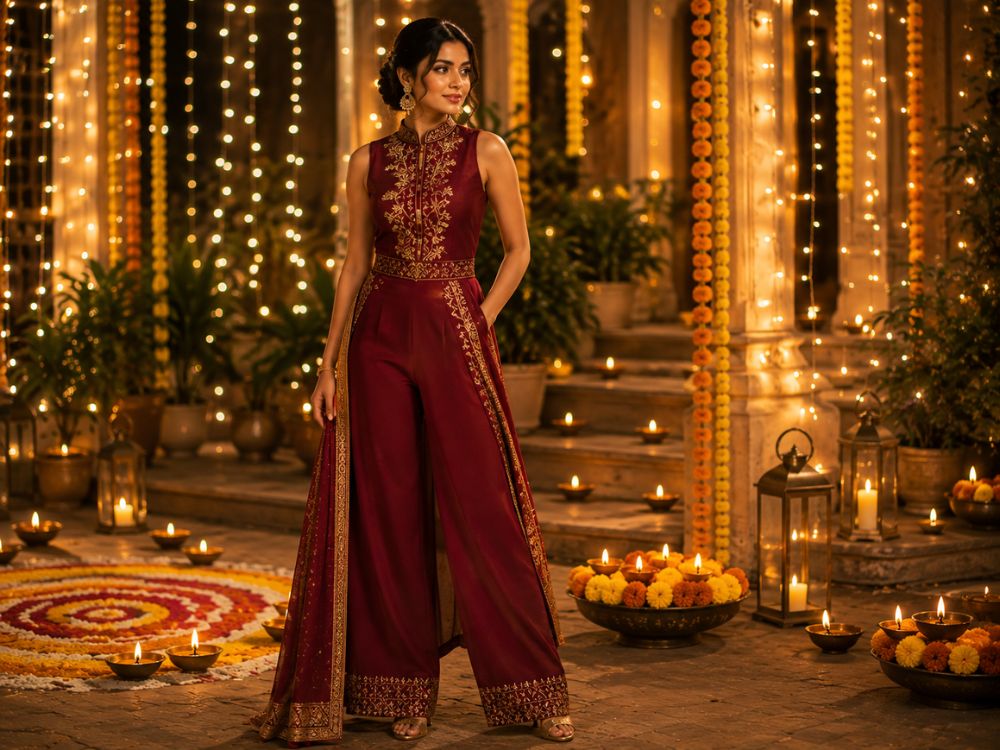
Fusion looks blend Western silhouettes with festive embellishment, popular among younger shoppers browsing AI prompts for Diwali outfits.
This category is trickier to prompt well because “fusion” means different things to different people. Naming which element is Western and which is traditional keeps the AI from defaulting to a vague, undefined middle ground.
How to Apply This Prompt
Describe the Western silhouette first (jumpsuit, cape, dress), then layer in the traditional embroidery detail.
Festive Details & Accessories Prompts
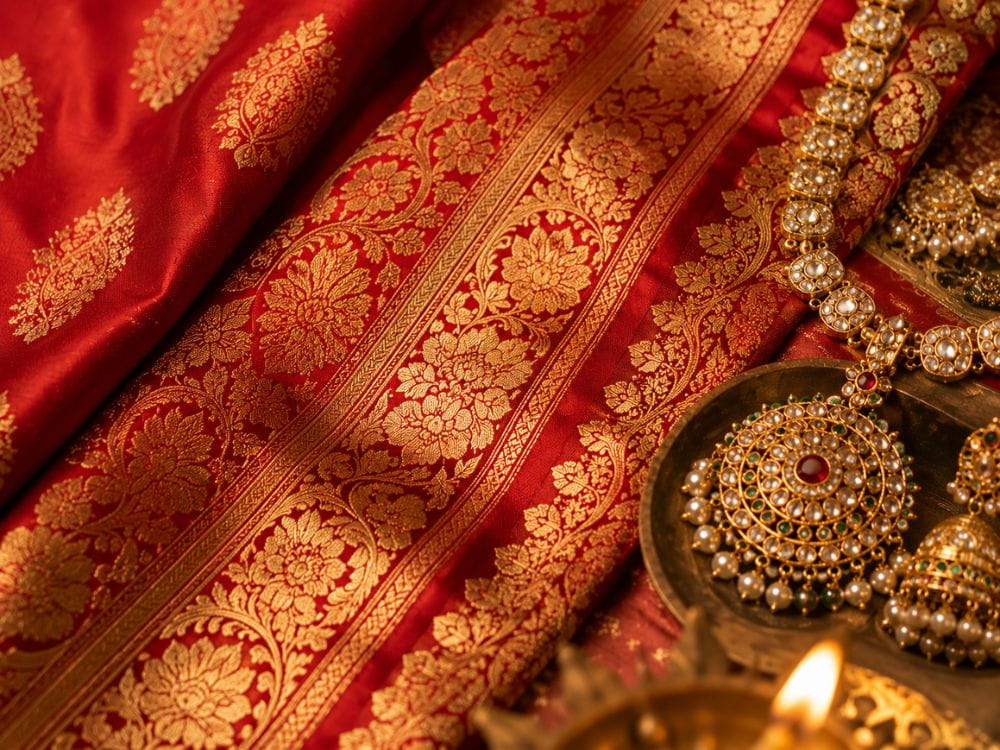
Close-up detail prompts are useful for boutique marketing and product photography around Diwali collections.
Detail shots are also the easiest entry point if you’re new to writing AI prompts for Diwali outfits, since a single close-up has far fewer variables to get wrong than a full-body portrait.
How to Apply This Prompt
Zoom the prompt in with “close-up” or “macro detail” and describe a single element rather than a full outfit.
Festive Color Palette Guide for AI Prompts
Color does more work than almost any other variable when writing AI prompts for Diwali outfits. Getting the palette right is often the difference between a result that feels festive and one that feels like an ordinary portrait with a lamp in the background.
Traditional gold and red. This remains the most requested Diwali palette, and for good reason — it photographs well against both diya lighting and rangoli backdrops. Prompts that pair “deep red” or “maroon” with “gold zari” or “gold thread embroidery” tend to produce the most instantly recognizable festive look.
Marigold orange and mustard. These warmer tones echo the flowers used in Diwali decorations themselves, which means AI models often place the subject convincingly against floral backdrops without much extra prompting. This palette also photographs beautifully under the warm, low evening light typical of festival shoots.
Jewel tones — emerald, sapphire, and amethyst. These colors work well for anyone who wants a festive look without leaning on red or gold. They pair particularly well with gold embroidery as an accent rather than the dominant color, and they photograph well in both daylight and string-light settings.
Pastels with metallic accents. A newer trend among younger shoppers, pastel pink, mint, or lavender paired with gold or silver detailing gives a softer, more contemporary take on festive dressing. This palette works especially well for the fusion prompts covered later in this guide.
When you’re unsure which palette to try first, start with traditional gold and red — it has the most training data behind it and tends to produce the most consistent, polished results across different AI tools.
Regional Diwali Style Variations Worth Trying
India’s regional diversity means “Diwali outfit” can look very different depending on where the wearer is from, and naming a region in your AI prompts for Diwali outfits often improves accuracy.
North Indian styles tend to favor heavier embroidery, brighter colors, and structured silhouettes like anarkalis and sherwanis, especially for evening celebrations and family gatherings.
South Indian styles lean toward silk sarees like Kanjeevaram and Mysore silk, often in richer, more saturated colors with temple jewelry as the finishing touch.
Gujarati and Rajasthani styles bring in mirror work, bandhani prints, and brighter, more playful color combinations, which suit prompts involving dance and movement particularly well.
Bengali styles often favor red-and-white color combinations with gold borders, giving a slightly different visual signature than the red-and-gold pairing common elsewhere.
None of this means you need to stick rigidly to one region. Many of the most interesting AI-generated festive looks come from deliberately mixing elements — a Kanjeevaram silk in an unconventional silhouette, for example. The key is naming the specific elements you’re borrowing from, rather than leaving the AI to guess at an undefined “traditional” look.
Planning a Full Diwali Photoshoot Around These Prompts
Once you’ve picked a few favorite AI prompts for Diwali outfits, it helps to think about how they’ll work together as a full shoot or lookbook, rather than as isolated images.
Group by lighting first. Warm, candlelit prompts and bright daylight prompts feel jarring when placed side by side in a single collection. Pick one dominant lighting mood for a cohesive set, then use one or two contrasting shots as accents.
Vary the shot type. A lookbook built entirely from full-body portraits feels repetitive. Mix in the detail and accessory prompts from this guide – a close-up of henna, a macro shot of jewellery – to break up the rhythm the way a real photographer would.
Keep a consistent color story. If your saree prompts lean toward red and gold, carry that same palette into your lehenga and menswear prompts rather than switching to jewel tones halfway through. This makes the final collection feel intentional rather than scattered.
Save prompt variations, not just final images. When a prompt produces a result you like, save the exact wording alongside the output. If a client or customer wants a similar look in a different color, you can reuse the same structure and swap only the color and fabric terms.
This kind of planning turns a set of individual prompts into something that reads like a real festive collection — which matters whether you’re building content for a blog, a boutique’s Instagram, or a client pitch deck.
Timing Your Festive Content Around Diwali
Search interest and shopping behaviour around Diwali follow a fairly predictable pattern each year, and it’s worth planning AI-generated content around that curve rather than reacting to it.
Interest in festive fashion typically starts climbing about a month before the festival, as people begin planning outfits, decor, and gifts. This early window is the best time to publish AI prompts for Diwali outfits content, since readers are actively researching ideas rather than making last-minute decisions.
The two weeks immediately before Diwali see the sharpest spike in both search volume and actual purchases. Content published during this window performs well if it’s more decision-focused — comparisons, “what to wear” guides, or last-minute styling ideas — rather than broad inspiration pieces.
After the festival itself, interest drops quickly but doesn’t disappear. Some searches continue from people planning for related celebrations like Bhai Dooj or looking ahead to the next wedding season, which is a reasonable moment to link this guide to related content like bridal or wedding-season prompts.
Publishing this guide a few weeks ahead of Diwali, then updating it slightly each year with fresh prompt ideas, tends to perform better over time than publishing once and leaving it untouched — search engines generally favor content that shows signs of being kept current.
Common Mistakes to Avoid
Even with a strong formula, a few habits weaken results when writing AI prompts for Diwali outfits.
- Being too vague. “Diwali dress” gives the AI little to work with. Name garment, fabric, color, and setting.
- Skipping festival cues. Diyas, rangoli, and fairy lights instantly signal the occasion — leaving them out makes results feel generic.
- Overloading the prompt. Too many adjectives confuse the model. Pick the three or four details that matter most.
- Ignoring lighting. “Warm evening light” and “bright daylight” produce completely different festive moods.
- Not iterating. Treat your first output as a draft, not a final result.
- Skipping the photography style reference. Naming a style — editorial, documentary, candid — gives the AI a compositional framework instead of leaving it to guess.
- Using contradictory descriptors. Asking for “minimalist, heavily embellished” in the same prompt confuses the model. Pick one direction and commit to it.
Choosing an AI Tool for Festive Prompts
Midjourney tends to produce richer, more cinematic color grading, which suits festive gold-and-jewel-tone palettes well. DALL-E often gives cleaner, more literal results when you need precise control over a specific detail.
Tools built on Stable Diffusion sit somewhere in between and offer more technical customization if you’re comfortable adjusting settings like sampling steps.
Testing the same prompt across two or three tools is a common workflow among designers building festive lookbooks, since each platform interprets color and lighting cues slightly differently.
If you enjoyed this guide, our Bridal AI Fashion Prompts article covers a similar formula for wedding looks, and How to Write AI Fashion Prompts breaks down the fundamentals in more depth. For saree-specific techniques, see AI Prompts for Saree Photography.
For the tools themselves, Midjourney’s official site and OpenAI’s DALL-E page are worth bookmarking, since both update their rendering capabilities regularly.
FAQ: AI Prompts for Diwali Outfits
1. What are AI prompts for Diwali outfits used for?
They’re text descriptions used with AI image generators like Midjourney or DALL-E to visualize festive outfit concepts — sarees, lehengas, kurtas, and fusion looks — before shopping or designing.
2. Which AI tool works best for festive fashion prompts?
Midjourney tends to produce richer, more cinematic festive color tones, while DALL-E gives cleaner, more literal interpretations. Many designers test both.
3. How do I make festive AI prompts look more authentic?
Add festival-specific cues like diyas, rangoli, and marigold flowers, along with a warm lighting reference. These details push the AI toward an authentic Diwali mood rather than a generic festive look.
4. Can these prompts work for other festivals too?
Yes. Swap the Diwali-specific cues (diyas, rangoli) for the relevant festival’s symbols, and the same garment-fabric-color-setting formula still applies.
5. Do I need fashion vocabulary to write good prompts?
Not necessarily. Starting with the basic formula in this guide — garment, fabric, color, setting, lighting, mood — gets you most of the way there.
6. Can I use these prompts for menswear too?
Yes. The Men’s Kurta & Sherwani section above uses the same formula, just with menswear-specific garment and collar terms.
7. What’s the biggest difference between prompting for Diwali versus a regular festive shoot?
The festival-specific cues make the biggest difference. Diyas, rangoli, marigold flowers, and warm evening lighting are what signal “Diwali” specifically rather than a generic festive occasion. Leaving these out tends to produce a technically nice outfit shot that doesn’t read as tied to the festival at all.
8. How many prompt variations should I generate before choosing a final look?
Most designers find three to five variations of the same prompt — changing one variable like color or setting each time — is enough to spot a clear favorite. Generating dozens of nearly identical images rarely reveals anything new; it’s more useful to change the fabric, lighting, or setting between rounds.
9. Should I mention specific jewelry brands or designers in my prompts?
No. Naming real brands or designers in a prompt doesn’t reliably improve accuracy, since most AI image tools aren’t trained to reproduce specific branded products, and doing so can also raise licensing and trademark concerns depending on how the output is used. Describing the jewelry style itself — temple jewelry, kundan, polki — works better and keeps the output fully original.
Which of these AI prompts for Diwali outfits will you try first? Save your favorites and tweak the color palette to match your own festive collection or personal style.