
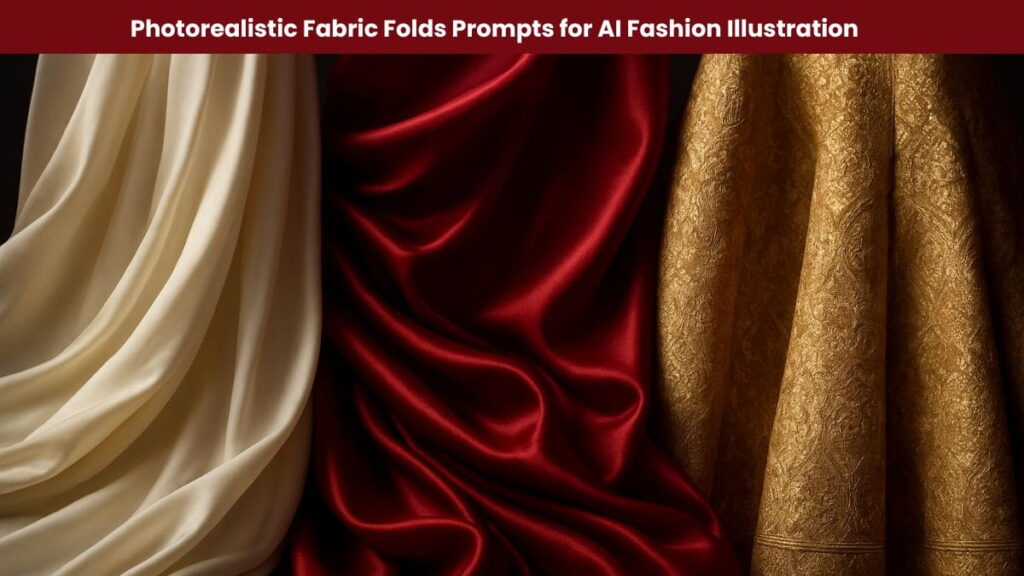
Introduction: Why Fabric Folds Are the Ultimate Test of AI Fashion Realism
In AI-generated fashion imagery, nothing reveals quality faster than fabric folds. You can design a stunning outfit, choose the perfect color palette, and pose a model beautifully — but if the fabric drape looks flat, plastic, or painted, the image instantly loses credibility.
This is why photorealistic fabric folds prompts are one of the most valuable skills in AI fashion illustration today.
Fashion designers, digital artists, textile creators, and AI prompt sellers all face the same challenge:
Table of Contents
- Introduction: Why Fabric Folds Define Realism
- What Are Photorealistic Fabric Folds Prompts?
- Why AI Struggles With Fabric Folds
- Understanding Fabric Behavior
- 5 Core Elements of Fabric Fold Prompts
- The Ultimate Prompt Formula
- Fabric-Specific Prompt Engineering
- 15 Ready-to-Use Fabric Fold Prompts
- Negative Prompts for Realism
- Post-Processing Tips
- Best AI Models for Fabric Realism
- Common Mistakes
- FAQ
👉 How do I make AI-generated fabric behave like real fabric?
This pillar article answers that question in depth.
You will learn:
- A proven prompt formula used by professionals. Fabric-specific prompt strategies (silk, cotton, velvet, chiffon, brocade)
- Negative prompts that prevent plastic results
- Before → after prompt transformationsPost-processing tips to elevate realism
- SEO and monetization strategies using fabric prompts
By the end, you will fully understand how to write photorealistic fabric folds prompts that consistently produce premium, editorial-quality fashion images.
What Are Photorealistic Fabric Folds Prompts?
Photorealistic fabric folds prompts are advanced AI prompts that describe fabric behavior the same way a fashion photographer, stylist, or textile designer would.
They go beyond basic clothing descriptions and include:
- Fabric type and weight
- Surface finish and texture
- Fold behavior and gravity
- Lighting direction and intensity
- Camera perspective and depth
Compare these two prompts:
❌ “A dress with folds.”
✅ “A silk dress with flowing cascading folds, soft rim lighting, 85mm lens, photorealistic texture.”
The second prompt gives AI enough information to simulate real-world fabric physics.
Why AI Struggles With Fabric Folds
AI image models don’t understand fabric — they predict visuals based on language patterns.
Fabric folds are difficult because:
- They are three-dimensional
- They depend on gravity and tension
- They react differently to light
- Each fabric behaves uniquely
Without guidance, AI defaults to:
- Smooth, plastic-like surfaces
- Random wrinkles
- Flat shading
This is why photorealistic fabric folds prompts are essential — they replace ambiguity with precision.
If you’re new to structured prompts, start with our free AI fashion prompts collection to experiment with realistic garment rendering.
Understanding Fabric Behavior (Simple & Practical)
You don’t need textile engineering knowledge, but understanding how fabrics behave helps you prompt better.
Fabric Weight & Fold Behavior
| Fabric | Weight | Fold Characteristics |
| Silk | Light–Medium | Fluid, glossy, cascading |
| Cotton | Medium | Crisp, structured |
| Velvet | Heavy | Deep, rounded |
| Chiffon | Very light | Airy, floating |
| Brocade | Stiff | Sculpted, sharp |
When you include these characteristics in your prompt, AI generates folds that look believable.
The 5 Core Elements of Photorealistic Fabric Folds Prompts
1. Fabric Name (Never Skip This)
Always explicitly name the fabric.
Bad:
- “flowing dress”
Good:
- “flowing silk dress”
AI relies heavily on material cues.
2. Fabric Weight & Surface Finish
Weight controls depth of folds.
Finish controls light reflection.
Examples:
- lightweight chiffon
- heavy velvet
- matte cotton
This alone can dramatically improve realism.
3. Fold Language (Most Important Element)
This is where most prompts fail.
Avoid vague terms like:
- nice folds
- soft fabric
- draped nicely
Instead, use action-based fold language:
- cascading folds
- sharp pleats
- gathered at the waist
- layered drape
- flowing ripples
- sculptural folds
This language tells AI how the fabric moves.
4. Lighting That Reveals Fabric Depth
Lighting creates shadows between folds.
Best lighting terms:
- softbox lighting
- side lighting
- studio fashion lighting
- golden hour backlight
Flat lighting = flat fabric.
5. Camera & Composition
Camera terms increase realism because AI has learned photographic patterns.
Use:
- macro close-up
- 85mm lens
- 50mm lens
- shallow depth of field
- editorial fashion photography
The Ultimate Prompt Formula for Fabric Folds
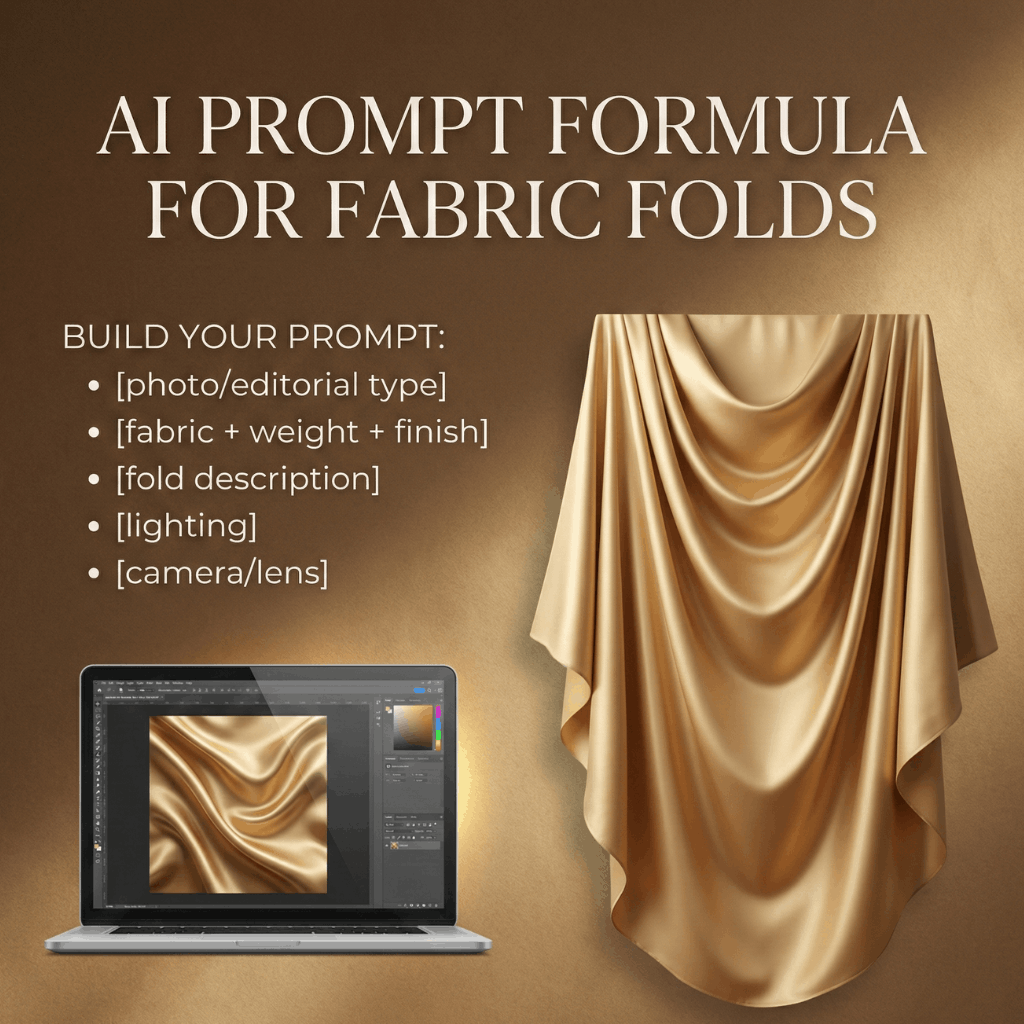
Use this formula consistently:
Example (Silk Saree)
1. Silk Saree – Editorial Fabric Fold Prompt
View Prompt
This structure is the backbone of photorealistic fabric folds prompts.
Fabric-Specific Prompt Engineering (Deep Dive)
Silk Fabric Prompts
Silk reflects light and flows smoothly.
Keywords:
- glossy silk
- satin sheen
- cascading folds
Tip: Always add lighting to control reflections.
Cotton Fabric Prompts
Cotton is matte and structured.
Keywords:
- crisp folds
- pressed creases
- matte texture
- structured drape
Avoid glossy lighting.
Velvet Fabric Prompts
Velvet absorbs light.
Keywords:
- heavy velvet
- deep rounded folds
- soft shadow gradients
- minimal highlights
Use moody side lighting.
Chiffon Fabric Prompts
Chiffon is airy and translucent.
Keywords:
- lightweight chiffon
- translucent fabric
- floating ripples
- wind movement
Golden hour lighting works best.
Brocade Fabric Prompts
Brocade is stiff and ornate.
Keywords:
- stiff brocade
- sculpted pleats
- embroidered texture
- structured folds
Macro close-ups enhance detail.
15 Ready-to-Use Photorealistic Fabric Folds Prompts
Luxury Silk Saree Editorial
Royal Bridal Lehenga
Minimal Cotton Kurta Style
Velvet Evening Gown
Chiffon Saree Wind Effect
Modern Indo Western Dress
Men’s Classic Blazer Style
Luxury Red Carpet Dress
Kids Festival Lehenga
Bridal Dupatta Portrait
Street Fashion Outfit
Luxury Resort Wear
Designer Couture Runway
Saree Fabric Macro
Elegant Evening Fashion
Negative Prompts: Protecting Fabric Realism
Negative prompts prevent AI from ruining realism.
Use:
Negative Prompt – Remove Unrealistic Fabric
Negative prompts are essential for photorealistic fabric folds prompts.
Before → After: Why Prompt Quality Matters
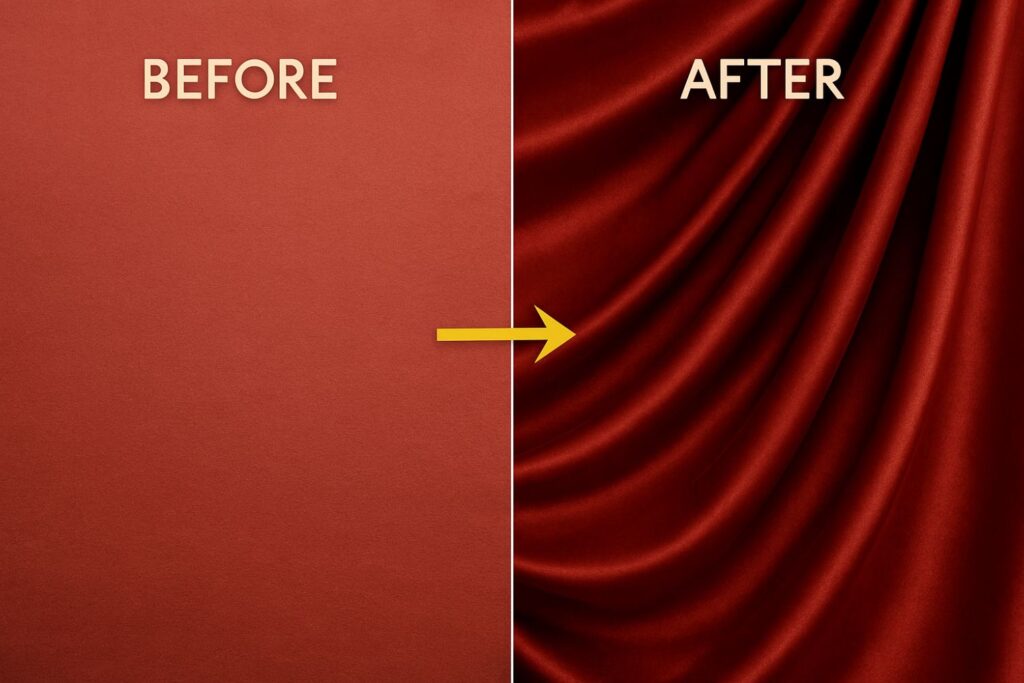
Example: Silk Saree
❌ Before:
1. Silk Saree – Basic Prompt
✅ After:
1. Silk Saree – Editorial Fabric Fold Prompt
Result:
- Depth
- Shine
- Natural drape
- Professional look
Post-Processing Tips to Enhance Fabric Folds
Even strong AI images benefit from light editing.
Recommended Adjustments:
- Increase local contrast
- Dodge highlights on fold ridges
- Burn shadows between folds
- Add subtle texture sharpening
- Reduce over-smoothing
This elevates AI outputs to editorial quality.
Best AI Models for Fabric Fold Realism
- MidJourney – best for high-fashion editorial
- Stable Diffusion (img2img) – best for control
- Leonardo AI – strong texture detail
- DALL·E – clean commercial visuals
Your photorealistic fabric folds prompts work across all.
Common Mistakes That Kill Fabric Realism
- Not naming the fabric
- Using vague language
- Ignoring lighting
- No camera terms
- Overloading styles
Fix these, and quality improves instantly.
Final Checklist (Save This)
Before generating:
✅ Fabric name
✅ Weight & finish
✅ Fold behavior
✅ Lighting
✅ Came
✅ Negative prompt
Conclusion: Why Fabric Folds Are Your Competitive Advantage
As AI fashion grows, realistic fabric drape becomes the quality benchmark. Anyone can generate clothes — but few can generate believable fabric.
Mastering photorealistic fabric folds prompts allows you to:
- Create premium visuals
- Sell digital products
- Build authority
- Work faster
- Stand out globally
This skill future-proofs your fashion career.
Final CTA
🎁 Download 15 Free Photorealistic Fabric Folds Prompts
🛍 Explore Ultra-Detailed AI Fashion Prompt Packs
📸 View Before → After Gallery Examples
Start creating fashion visuals that look real.
For advanced prompt structuring, refer to the official Midjourney documentation to understand how descriptive language affects image output.
FAQ
Q1: What are photorealistic fabric folds prompts?
Photorealistic fabric folds prompts are structured AI prompts designed to recreate realistic fabric drape, folds, and texture in AI-generated fashion images.
Q2: Which AI model works best for fabric folds?
Midjourney and Stable Diffusion offer the most realistic fabric fold rendering when combined with detailed prompt structure.
Q3: How do I avoid plastic-looking fabric in AI images?
Use negative prompts like “plastic texture,” “flat fabric,” and add lighting and camera details to your prompt.